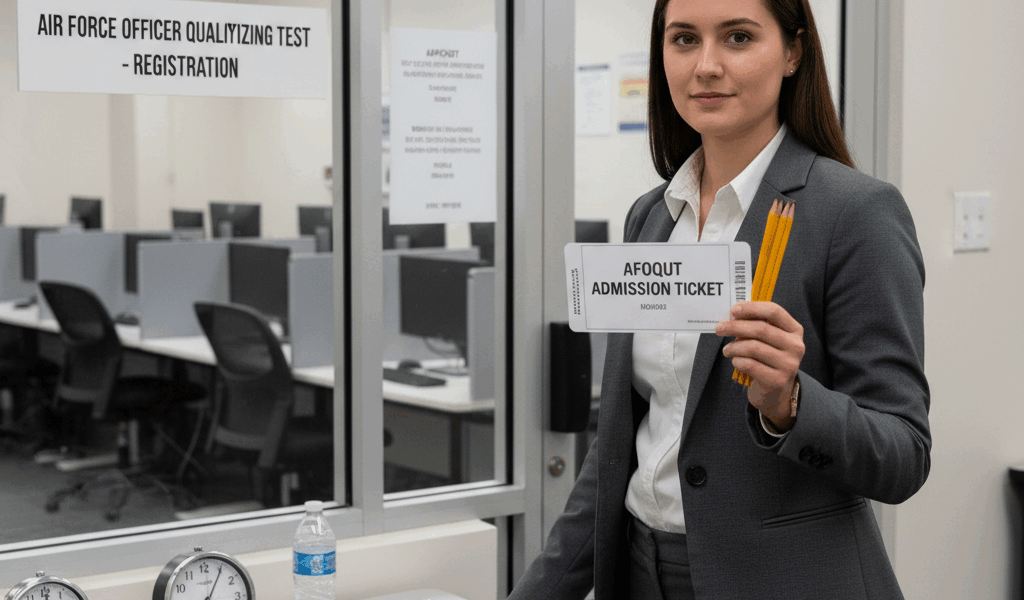
AFOQT test day preparation has gotten complicated with all the conflicting advice flying around online.
You’ve spent weeks or months preparing. Now, with test day approaching, the final 24 hours can make a significant difference in your performance. This comprehensive checklist will help you navigate the crucial period from the night before through your arrival at the testing center.
The Night Before: Setting Yourself Up for Success
Probably should have led with this section, honestly. The evening before your AFOQT is not the time for last-minute cramming. Research consistently shows that sleep quality has a greater impact on cognitive performance than additional study time. Instead, focus on preparation and relaxation.
Gather Your Required Materials:
- Valid government-issued photo ID (military ID or driver’s license)
- Test authorization letter or scheduling confirmation
- Two or three sharpened No. 2 pencils with good erasers
- Quiet snacks for breaks (nuts, granola bars, or fruit)
- A bottle of water
Evening Routine Recommendations:
- Eat a balanced dinner that is not too heavy or spicy
- Avoid alcohol and excessive caffeine after noon
- Set multiple alarms to ensure you wake up on time
- Lay out comfortable clothes that comply with any dress code requirements
- Review your route to the testing center and check for traffic or construction updates
Plan to get at least seven to eight hours of sleep. Go to bed at your normal time rather than trying to sleep earlier, which often leads to frustration and restlessness.

What to Bring to the Test Center
Test center policies are strict, and bringing prohibited items can cause delays or even disqualification. Pack your bag carefully with only approved items.
Required Items:
- Valid photo identification
- Test authorization documentation
- Several No. 2 pencils with erasers
Recommended Items:
- Light jacket or sweater (testing rooms are often cold)
- Reading glasses if you use them
- Quiet, easy-to-eat snacks
- Water bottle (may need to be stored in a locker)
What NOT to Bring
Electronic devices are strictly prohibited in most AFOQT testing environments. Leave these items at home or locked in your vehicle:
- Cell phones, smartwatches, or any electronic devices
- Calculators (you will be provided with scratch paper for calculations)
- Study materials, notes, or books
- Backpacks or large bags (small clear bags may be permitted)
- Food or drinks beyond what is allowed during breaks
Morning Routine Recommendations
That’s what makes test morning endearing to prepared candidates—everything is already done. Wake up with enough time to complete your morning routine without rushing. Stress hormones released when you feel rushed can impair cognitive function.
Morning Checklist:
- Eat a protein-rich breakfast (eggs, yogurt, oatmeal with nuts)
- Avoid excessive sugar that can cause energy crashes
- Have moderate caffeine if that is part of your normal routine
- Do light stretching or a short walk to get blood flowing
- Review your materials one final time to ensure nothing is forgotten
- Leave with plenty of time to spare, accounting for possible delays
Arriving at the Test Center
Plan to arrive at least 30 minutes before your scheduled test time. This buffer allows for unexpected delays and gives you time to settle in mentally.
When you arrive:
- Find parking and locate the testing room
- Visit the restroom before check-in
- Present your identification and complete any required paperwork
- Listen carefully to all instructions from test administrators
- Store any prohibited items in designated lockers or your vehicle

Mental Preparation Strategies
Your mindset going into the test is just as important as your content knowledge. Use these strategies to optimize your mental state:
Breathing Techniques: If you feel anxious, practice slow, deep breathing. Inhale for four counts, hold for four counts, and exhale for four counts. This activates your parasympathetic nervous system and reduces stress.
Positive Self-Talk: Replace negative thoughts like “I hope I do not fail” with positive affirmations such as “I am prepared and ready for this test.”
Visualization: Spend a few minutes visualizing yourself working through the test calmly and confidently, answering questions with focus and clarity.
Common Test Day Mistakes to Avoid
Many test-takers undermine their preparation by making preventable errors on test day:
- Skipping breakfast: Your brain needs fuel to perform optimally
- Arriving late: This creates stress and may result in being turned away
- Cramming the morning of: This increases anxiety without improving retention
- Forgetting identification: You cannot take the test without proper ID
- Wearing uncomfortable clothing: Physical discomfort distracts from the test
- Not using the restroom beforehand: You may not be able to leave during timed sections
What to Expect During the Test
The AFOQT consists of 12 subtests covering verbal analogies, arithmetic reasoning, word knowledge, math knowledge, reading comprehension, situational judgment, self-description, physical science, table reading, instrument comprehension, block counting, and aviation information.
The entire test takes approximately five hours with breaks. Each subtest is timed separately, and you will receive instructions before each section. Work at a steady pace, and do not spend too much time on any single question. If you are unsure of an answer, make your best educated guess and move on.
Remember that the AFOQT is designed to assess your potential as an Air Force officer. Trust in your preparation, stay calm, and approach each question methodically. Your months of hard work have prepared you for this moment.
Good luck on your AFOQT. With proper preparation the night before and morning of your test, you are positioned to perform at your best.
The exam itself has no candidate fee; review our AFOQT cost, scheduling, and authorized retest guide before finalizing travel plans.


Stay in the loop
Get the latest afoqt prep updates delivered to your inbox.