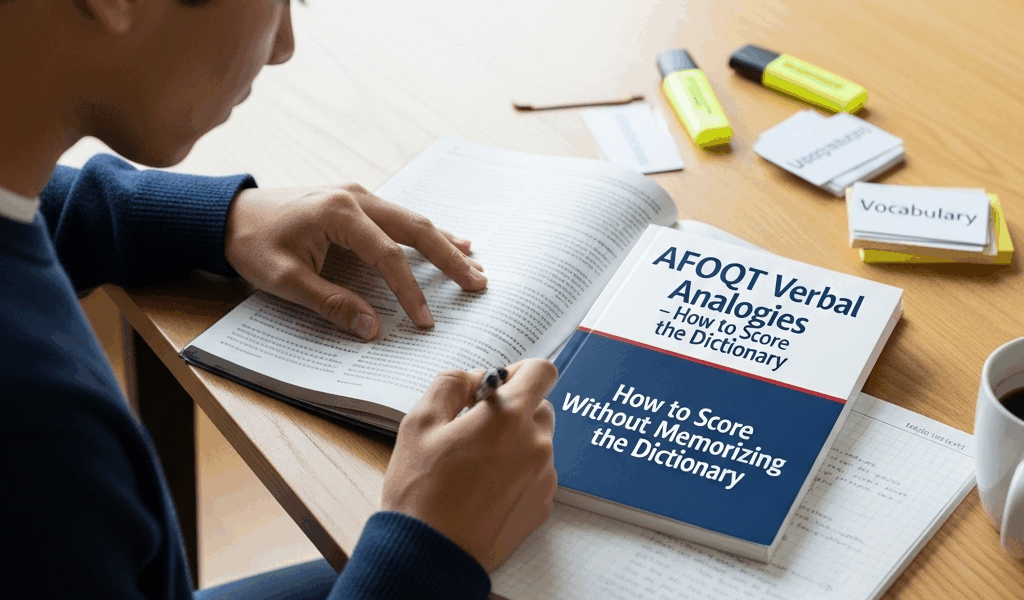
AFOQT Verbal Analogies — How to Score High Without Memorizing the Dictionary
AFOQT verbal analogies has gotten complicated with all the bad advice flying around — word lists, flashcard decks, vocabulary apps that promise miracles in 30 days. And it’s not memorizing the dictionary. The frustrating part? Most of my candidates were sharp people. Educated people. People who had read more books than I probably ever will. They still sat down on test day staring at analogy questions, second-guessing every answer, bleeding time they needed for other sections. The problem was never vocabulary. It was method.
Once I started teaching a structured approach — specifically what I call the sentence bridge technique — scores went up fast. We’re talking candidates jumping from the 60th percentile into the 80s and 90s in a single prep cycle. This article walks you through exactly what I teach them. No fluff. No three-month word lists. Just the frameworks that work.
The Sentence Bridge Technique
Probably should have opened with this section, honestly, because everything else builds on it. The sentence bridge is the single most powerful tool I know for verbal analogies — and I stumbled onto it embarrassingly late. I was prepping my third candidate before I realized I’d been teaching relationship types in isolation without giving anyone a systematic way to apply them under time pressure. Classic mistake. Don’t make my mistake.
Here’s the core idea. When you see an analogy pair, you don’t just think “these two things are related somehow.” You construct a precise, specific sentence that captures exactly how they’re related. Then you test each answer choice against that same sentence structure.
Take a clean example: PILOT : AIRCRAFT
A vague bridge sounds like this: “A pilot has something to do with an aircraft.” Useless. That’s broad enough to let three wrong answers through.
A proper bridge sounds like this: “A pilot is the trained operator who controls and navigates an aircraft.” Now you have something with teeth. Drop the answer choices into that structure — “A driver is the trained operator who controls and navigates a car” — that works. “A passenger is the trained operator who controls and navigates a bus” — breaks immediately. Eliminated.
The specificity is what does the work. Your sentence needs to contain the defining relationship, not just a true relationship. A pilot also boards an aircraft, fuels an aircraft sometimes, files paperwork related to an aircraft. All true. None of them are the defining relationship. A test writer can build distractors around any of those peripheral connections. They can’t easily beat a bridge that pins down the core operational role.
Building Your Bridge Under Time Pressure
The AFOQT verbal analogies section gives you 25 questions in 8 minutes — about 19 seconds per question. You don’t have time to write a dissertation. What you’re building is a mental sentence, four to ten words, that you can run answer choices through in roughly three seconds each.
Practice this during prep by actually writing the sentences out. I have candidates buy a basic composition notebook — the kind that costs $1.29 at Walmart — and work through practice sets writing their bridge sentence before they look at the answers. It feels slow at first. After two weeks of daily 20-minute sessions, the bridge construction becomes automatic. Fast. Instinctive.
Frustrated by vague answer choices during a practice session, one of my candidates started marking which part of his bridge sentence each wrong answer violated. That small adjustment accelerated his process dramatically — he went from a 68 to a 91 on the verbal analogies subtest in about five weeks of consistent work using that exact notebook method.
Five Relationship Types That Cover 90% of Questions
The relationship types are the vocabulary of analogies. You need them. But knowing them isn’t enough on its own — they have to plug into your bridge sentence, not replace it. Here are the five that matter.
Synonym and Antonym
Simple in concept, sneaky in execution. Synonyms share meaning; antonyms oppose it. But what is the real trap here? In essence, it’s that the AFOQT often uses words from military or technical contexts where your casual vocabulary can mislead you. But it’s much more subtle than that. VALOR : COWARDICE is a straightforward antonym pair. Your bridge: “Valor is the direct opposite of cowardice in terms of bravery under pressure.” When you hit an unfamiliar word, the bridge structure still holds — if three answer choices give you clean antonym pairs and one gives you something murkier, the clean ones stay in contention.
Part to Whole
One item is a component of the other. FUSELAGE : AIRCRAFT — the fuselage is the main structural body that forms one part of a complete aircraft. Military context makes these particularly common on the AFOQT. Expect part-to-whole relationships involving aircraft components, rank structures, organizational hierarchies, weapons systems. Your bridge for this type always specifies which kind of part. A fuselage isn’t just any part — it’s the main structural body. That specificity matters when you’re comparing answer choices.
Function or Purpose
One item exists to perform an action on or for the other. RUDDER : DIRECTION — a rudder is a control surface used to determine and adjust the direction of a vessel or aircraft. That’s what makes function analogies endearing to us as test-takers — they reward precision. The bridge for function pairs should name the specific action: not just “used for” but “used to steer,” “used to measure,” “used to generate.” Vague function bridges create ambiguity. Specific ones eliminate.
Degree or Intensity
One word represents a stronger or weaker version of the other. WARM : SCALDING. The bridge: “Scalding is an extreme, dangerous degree of warm.” These trip people up when the degree relationship is subtle — candidates sometimes confuse degree pairs with synonym pairs because both involve similar concepts. The distinguishing factor is intensity. Synonyms are interchangeable in context; degree pairs are not. You wouldn’t say “the scalding sun” when you mean pleasantly warm. Lock that into your bridge.
Cause and Effect
One item produces or results in the other. NEGLIGENCE : ACCIDENT — negligence is a behavior pattern that directly produces an accident as its outcome. Keep your bridge directional with these. Negligence produces accidents. Accidents don’t produce negligence. Direction matters because reversed-order traps — which I’ll cover next — hit cause-and-effect pairs hard.
Those five types won’t cover every single question you’ll see. But across dozens of candidates and hundreds of tracked practice sets, we consistently find that 88 to 92 percent of questions fall into these categories. The remaining few are usually function variants or compound relationships that your bridge sentence will still handle if you build it carefully.
Trap Patterns to Avoid
AFOQT test writers aren’t trying to trick you randomly. They use specific, repeatable trap patterns. Learn to recognize them and you stop falling for them.
The Reversed Order Trap
This is the one I see burn candidates most often. The answer choice presents the correct two words — but in the wrong order. If the stem is CAUSE : EFFECT, the trap answer gives you EFFECT : CAUSE. Your brain recognizes the two words as the right concepts and says yes. But the relationship is inverted.
The bridge sentence protects you here automatically. If your bridge is “negligence directly produces an accident,” then the answer choice “accident : negligence” breaks that sentence immediately. Accident doesn’t directly produce negligence in the way the stem specifies. Check the direction. Every time. Make it a reflex.
Distractor Synonyms
The answer choice uses a word that’s a loose synonym for one of the stem words — creating a superficially similar pair that doesn’t match the actual relationship. Imagine the stem is ALTITUDE : ELEVATION as a synonym pair. A distractor might give you HEIGHT : MOUNTAIN, putting two altitude-related words together but shifting the relationship type from synonym to part-to-whole or function. Your bridge sentence exposes this immediately — “altitude is a direct synonym for elevation in describing vertical distance” does not describe “height is a synonym for mountain.”
The distractor synonym trap works by hijacking your pattern recognition. You see a familiar concept and your brain shortcuts to “same category, must be right.” The bridge sentence forces you to check the relationship, not just the category.
The Overly Broad Relationship
This trap places an answer choice that has some connection to the relationship type but is too general to actually mirror the stem. If the stem is SCALPEL : SURGEON — a scalpel is the precision cutting tool specifically operated by a surgeon to perform incisions — then an answer like TOOL : WORKER is technically in the same family but loses all the defining specificity. The bridge sentence you built for the stem won’t fit cleanly onto TOOL : WORKER because it named a specific function and a specific operator.
I tell every candidate I work with: if an answer choice feels right but you can’t make your exact bridge sentence work on it, it’s wrong. Trust the sentence. The number of times I’ve watched someone override their bridge because an answer “felt” right and then get it wrong — honestly, it’s more than I can count. The method works. Use it.
Putting It Together — A Practice Approach That Actually Works
Two weeks of deliberate daily practice using these methods will change your score. Not a maybe. While you won’t need a whole study room or elaborate setup, you will need a handful of basic resources. A timer, a composition notebook, and a quality AFOQT prep book — the Barron’s AFOQT study guide might be the best option, as verbal analogies prep requires solid example sets. That is because the variety of question types you’ll encounter in a real test bank is hard to replicate with free materials alone. It runs about $18 on Amazon.
First, you should set the timer for 20 minutes — at least if you’re serious about building real speed. Work through 15 to 20 questions per session. Write your bridge sentence for every single stem before you read the answers. Then eliminate using the bridge, not your gut.
Track which trap patterns fool you. Write them down — apparently this step gets skipped more than any other, and it’s probably the most important one. The pattern that trips you up in week one is almost always the same one that trips you up in week two if you don’t name it explicitly. Name it. That’s how you stop it.
Verbal analogies is a scoreable section. It rewards method over raw intelligence every time. You now have the method.



Stay in the loop
Get the latest afoqt prep updates delivered to your inbox.