Why Verbal Analogies Feel Impossible (And They’re Not)
I spent three weeks drilling AFOQT practice tests before I realized I’d been approaching verbal analogies all wrong. I’d memorized pairs of related words, treating each question like a vocabulary puzzle — at least that’s what I thought I should be doing. But that’s the trap. Verbal analogies don’t test how many synonyms you know. They test whether you can recognize the relationship between two words and replicate that relationship somewhere else entirely.
Most students feel blindsided because the word pairs seem random. You get a question like “Compass is to navigation as thermometer is to—” and suddenly you’re stuck wondering if you should know what a thermometer does. But that’s not what’s happening at all. The test is asking: What is the logical relationship between compass and navigation? Once you name that relationship, you apply it to find what thermometer does.
This section teaches pattern-spotting, not memorization. The five relationship types cover roughly 90% of what the AFOQT throws at you. Learning to identify them fast and accurately will cut your decision time in half.
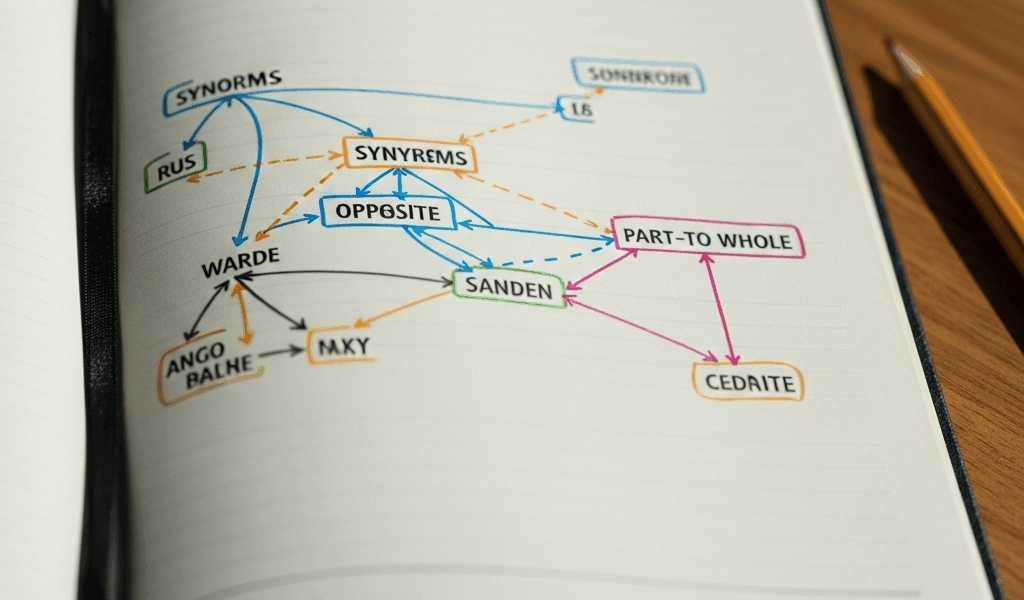
The 5 Core Relationship Patterns on the AFOQT
These five categories describe almost every analogy you’ll encounter. Knowing them by name makes them faster to spot — and honestly, that’s half the battle.
1. Synonym/Antonym
Pattern: Word A means the same as (or opposite to) Word B.
Example: Bright is to luminous as dim is to shadowy. Both pairs express the same quality through different vocabulary.
2. Part-to-Whole
Pattern: Word A is a component or piece of Word B.
Example: Strings are to guitar as keys are to piano. Each part belongs as an essential element of the whole.
3. Function/Purpose
Pattern: Word A does something to or with Word B; Word A is used for Word B.
Example: Saw is to cutting as hammer is to driving. The first word identifies a tool; the second identifies its primary purpose.
4. Degree/Intensity
Pattern: Word A and Word B describe the same quality at different intensities or scales.
Example: Warm is to hot as dislike is to hatred. One represents a milder version of the other.
5. Classification/Category
Pattern: Word A belongs to the group or category named by Word B.
Example: Salmon is to fish as oak is to tree. The first is a specific member; the second is its broader class.
Step-by-Step Method to Solve Any Analogy
This is the method I use every time. It works because it removes guessing.
Step 1: Identify the Relationship
Look at the first pair of words. Don’t think about their definitions — think about how they relate. Ask yourself: Is one a tool? Is one part of the other? Are they synonyms? Different intensities of the same thing?
Step 2: Define It in One Sentence
Write or think one clear statement of that relationship. Not a long explanation — one sentence. “A scalpel is a tool used for precision cutting.” That’s your definition. It should be simple enough to test against every answer choice.
Step 3: Test Your Definition Against Each Answer
Read each answer choice and ask: Does this pair fit my definition? If my definition was “A tool used for precision cutting,” then I’m looking for a tool and the action it performs. Hammer and nail? No — the relationship is different there. Knife and slicing? Yes — same relationship type.
Step 4: Eliminate by Relationship Fit, Not Vocabulary
The answer isn’t the one with the smartest or most sophisticated words. It’s the one where the relationship matches. If two answers sound related but don’t match your definition, eliminate them both.
Worked Example
Compass is to navigation as thermometer is to—
Step 1: A compass is a tool used for determining direction during navigation. That’s a function/purpose relationship.
Step 2: “A compass is a tool that enables or supports navigation.”
Step 3: Now I check answer choices (hypothetically): measurement, temperature, weather, altitude, direction.
Step 4: A thermometer is a tool used for measurement — specifically of temperature. That’s the same relationship type. The correct answer would be measurement. Temperature is what the thermometer measures, but measurement is the function, just like navigation is the function a compass serves.
Worked Examples with Real AFOQT-Style Questions
Example 1: Degree/Intensity
Annoyed is to furious as concerned is to—
Relationship Definition: Annoyed and furious both describe negative emotional states, but furious is more intense. This is a degree/intensity pattern.
Testing against answers: If the pattern is “a mild version to an intense version,” then I’m looking for a mild concern paired with an intense form of concern.
Correct answer: Panicked (or alarmed, frantic). Concerned describes mild worry; panicked describes extreme worry. Same emotional spectrum, different points on the intensity scale.
Why wrong answers fail: Scared doesn’t mirror the mildness-to-intensity arc. Nervous is too similar in intensity to concerned. Peaceful goes in the opposite direction. Thoughtful is just unrelated.
Example 2: Part-to-Whole
Scene is to screenplay as chapter is to—
Relationship Definition: A scene is a structural unit that makes up a screenplay. This is part-to-whole.
Testing against answers: I need a small structural unit that belongs as a building block to something larger.
Correct answer: Novel. A chapter is a structural component of a novel, just as a scene is a component of a screenplay.
Why wrong answers fail: Story is too broad and not a structural component. Plot is a broader concept, not a piece. Page is physical, not narrative. Dialogue is a feature within structures, not a structure itself.
Example 3: Function/Purpose
Lens is to focusing as catalyst is to—
Relationship Definition: A lens is an optical tool whose function is to focus light. A catalyst does something to a process.
Testing against answers: I need something that performs a specific action or enables a specific outcome — like how a catalyst speeds up or enables a chemical reaction.
Correct answer: Accelerating. A catalyst accelerates a chemical reaction, just as a lens enables focusing.
Why wrong answers fail: Reaction is what a catalyst affects, not what it does. Transformation is too vague. Chemistry is the field, not the function. Burning is an unrelated outcome.
Common Traps and How to Avoid Them
Trap 1: Choosing Related Words That Don’t Match the Relationship
Two words can obviously relate without matching your defined relationship. I learned this the hard way by picking “volcano and lava” when the original pair was “source and water.” Both pairs involve origin and material, right? Wrong. The first pair is part-to-whole; the second is source-to-product. The relationship type was different, even though both pairs were thematically connected.
Corrective tip: Repeat your one-sentence definition of the relationship before you look at answers. Then check: does this answer pair fit that specific sentence, or does it just sound related?
Trap 2: Forcing Vocabulary Knowledge Instead of Using Logic
You see a word you don’t know in the original pair, panic, and pick an answer with a word you recognize. But the AFOQT rarely requires obscure vocabulary. If you don’t know a word, focus on the relationship. The relationship between unfamiliar words is usually clear from context.
Corrective tip: If you’re stuck on vocabulary, re-read the pair and look for structural clues. Does one word seem to describe an action? Does one sound like a category? You can often infer the relationship without knowing both definitions perfectly.
Trap 3: Overthinking Simple Relationships
Sometimes the simplest relationship is right. I once spent two minutes convinced that “painter is to canvas” had to involve some subtle degree or classification pattern when it was just a straightforward function/purpose relationship. The painter uses the canvas to paint on it. That’s it.
Corrective tip: If your one-sentence definition feels complicated, stop and simplify it. The AFOQT relationships are usually clean and direct. If you’re writing a three-line explanation, you’re probably overcomplicating.
Quick Drill and Next Steps
Try the method on these three practice analogies. Work through all four steps for each.
- Microscope is to cells as telescope is to— (Define the relationship. What does a microscope do, and what does a telescope do?)
- Fearless is to timid as generous is to— (What relationship type is this? How are fearless and timid related?)
- Pedal is to bicycle as key is to— (Is this part-to-whole or function/purpose? What does each component do?)
Probably should have opened with practice drills, honestly. But working through examples after learning the patterns embeds them faster than either alone.
Verbal analogies typically appear in the Verbal Reasoning section of the AFOQT, usually accounting for 10–15 questions. Once you’re confident with these five patterns, move to timed practice. Set a limit of 45 seconds per question. Speed comes from pattern recognition, not rushed thinking. The more you name the relationship type before looking at answers, the faster you’ll recognize it automatically.
Verbal Analogies is one of two subtests assigned to the Verbal composite. If you are looking for an AFOQT reading section, see our official-subtest clarification before choosing practice materials.



Stay in the loop
Get the latest afoqt prep updates delivered to your inbox.