Why Your Instrument Comprehension Score Dropped
AFOQT prep has gotten complicated with all the generic “study harder” noise flying around. You searched for a fix because something went wrong — and not in a vague, hard-to-diagnose way. Your Instrument Comprehension score tanked your pilot composite, and now you’re sitting outside the qualifying threshold wondering how a subtest you barely heard about became the thing that derailed you.
As someone who has watched dozens of candidates blow this exact section, I’ve learned everything there is to know about how Instrument Comprehension destroys otherwise solid scores. Today, I will share it all with you.
Here’s the part nobody says out loud: most candidates spend weeks grinding Verbal and Quantitative. They polish Situational Judgment answers. Then they find a YouTube video the night before and call it Instrument Comprehension prep. That’s not a strategy. That’s academic roulette — and the house wins every time.
Your low score came from one of two specific failures. Almost certainly not both.
Either you were misreading the artificial horizon — flipping pitch orientation or losing track of which way is “up” — or you were reading compass headings backwards. One broken skill drops your score fast. Both broken? That’s a wall-to-wall collapse. Don’t make my mistake of assuming you’d figure it out under test conditions. You won’t.
Instrument Comprehension isn’t testing aviation knowledge. It’s testing pattern recognition under time pressure. You’re not reciting preflight procedures or explaining gyroscope mechanics. You’re reading an instrument correctly in 30 to 45 seconds. That’s a different animal entirely.
How to Read the Artificial Horizon Without Getting It Backwards
The artificial horizon is where most people bleed points. Probably should have opened with this section, honestly — fix your horizon reads and your confidence jumps immediately.
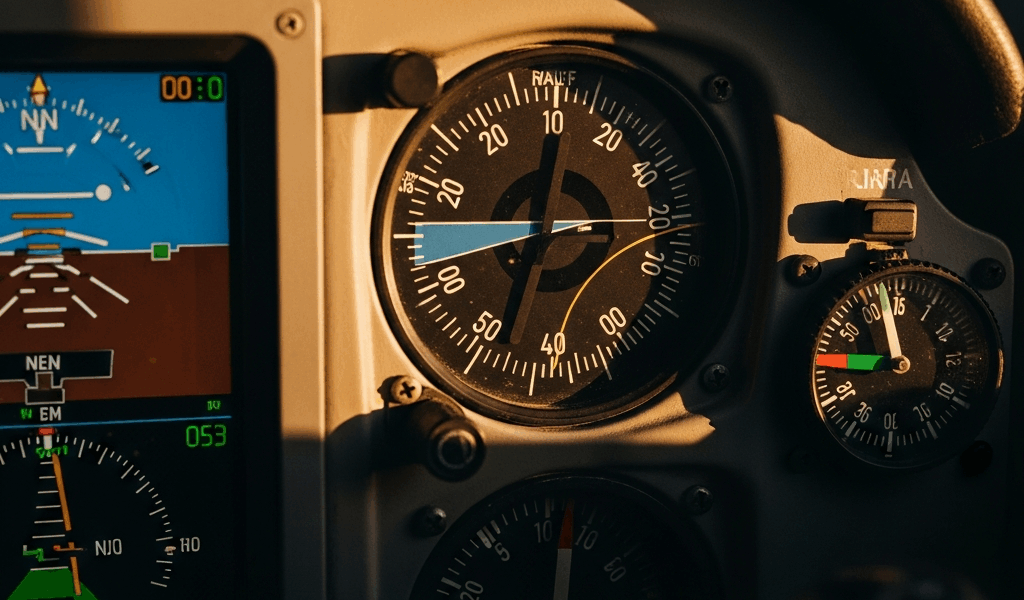
But what is the artificial horizon showing you? In essence, it’s the plane’s orientation relative to the real horizon. But it’s much more than that. The instrument displays the world from the aircraft’s perspective, not yours. You’re sitting in a chair. The plane is not.
Here’s what trips people up: the brown half isn’t just “ground color” and the blue half isn’t just “sky color.” The instrument is literally showing you what the plane sees. When the white reference line — the airplane symbol — tilts left, the plane banks left. Simple enough until test anxiety hits and your brain inverts the logic. Suddenly you’re reading everything backwards and marking wrong answers with total confidence.
Lock this in: The white airplane symbol is always the plane. Everything else moves relative to that fixed point.
Brown section rising toward the white symbol? Nose pitched up. Brown dropping away? Pitched down. The instrument doesn’t lie. Your eyes might — the instrument never does.
Four scenarios the way they’ll actually appear on the AFOQT:
- The white line is level with equal blue above and brown below. Level flight. Zero pitch. No climb, no descent. This one almost never shows up, but when it does, people overthink it into a wrong answer.
- The brown section is climbing toward the white symbol, covering roughly 15 degrees of the instrument. Nose pitched up 15 degrees. You’re climbing. That brown advancing upward isn’t an illusion — it’s the horizon falling away because your plane is going up.
- The white symbol has rolled 20 degrees to the right, brown section tilted the same direction. Right bank. Brown hasn’t shifted toward or away from the symbol, so pitch hasn’t changed. Level pitch, banking right. Straight coordinated turn.
- The symbol is pitched up 10 degrees and rolled left 25 degrees simultaneously. Nose up, left wing down — climbing and turning left at the same time. Read pitch first. Read bank second. Combine them. Both attitudes matter independently.
Practice drill: find an online AFOQT simulator — most run $15–$30 for a week of access, which is nothing compared to retesting fees — and do 20 horizon-only questions without a timer. Read each one carefully. Explain out loud what the plane is doing. Your brain builds this pattern through repetition, not explanation. Repetition is the whole mechanism.
Compass Heading Mistakes That Cost Easy Points
Compass heading questions look deceptively simple. Then you realize you’ve been reading them backwards for 15 questions straight. That’s a rough moment to have during an actual test.
The compass rose is a 360-degree circle. North sits at 0 (or 360). East is 90. South is 180. West is 270. A small airplane symbol inside shows the heading. Your job is to read where that nose points and report the degree value. Straightforward — until it isn’t.
The mistake happens fast. You see the nose pointing “up and to the right,” your brain says northeast, and you mark 045 degrees. Except the nose is actually pointing toward 315 degrees (northwest) because you didn’t account for rotation and just went with what felt right. I’m apparently wired to default to intuition on rotated compass images — and that intuition costs points every single time.
The single best mental anchor: Follow the nose, not your gut.
Put your finger on the airplane symbol’s nose. Trace a straight line out to the outer edge of the compass rose. Wherever that line meets the degree scale is your heading. Don’t guess. Don’t think about quadrants. Trace. Read. Mark. Done.
This is pure pattern recognition. Your brain needs 30 to 40 repetitions before it stops defaulting to intuition and starts reflexively tracing under time pressure. That’s just how procedural memory works — and there’s no shortcut around the repetition requirement.
Compass errors are usually systematic. You’ll probably make the same mistake repeatedly — consistently reading headings 180 degrees off, or rotating them 90 degrees in the same direction every time. Run 15 compass-only practice questions and track your errors on paper. The pattern will show up. It always does.
A 7-Day Drill Plan to Raise Your Score Fast
You don’t have weeks. You have days. So, without further ado, let’s dive in.
Days 1–3: Horizon interpretation only. Use a free online instrument trainer or a $20 AFOQT app — PrepHero and Trivium both have solid practice modes. Do 15–20 horizon questions daily. No timer. Just accuracy. You’re building visual pattern recognition, not test-taking speed. Write down what confused you after each session. That log matters later.
Days 4–5: Compass heading only. Same approach. 15–20 questions daily, no timer, trace every single heading. While you won’t need to memorize degree tables, you will need a handful of deliberate repetitions to wire this skill into reflex. Resist guessing. You’re training your hand and eye to work together — not your intuition.
Days 6–7: Mixed questions under full test conditions. Now combine both skills. Set a timer for 45 seconds per question — the actual AFOQT pace. Run full 20-question sections back-to-back. This is where you find out whether your skills hold under pressure or collapse the moment the clock appears.
Khan Academy has instrument basics videos for free. Most AFOQT prep apps run $15–$50 annually — that’s less than a single application fee. Military.com’s AFOQT section has free resources worth bookmarking. Some pilot training forums share free practice PDFs if you dig around. The materials exist. Using them consistently is the actual challenge.
What Score You Actually Need and When to Retest
Instrument Comprehension feeds directly into your pilot composite. The Air Force weights it heavily in pilot selection — which means even a 5 to 10 point improvement can push your composite above a qualifying threshold. That’s not a rounding error. That’s a program slot.
Most pilot programs require a pilot composite of 55 or higher. Competitive slots often want 65+. If you’re more than 10 points below your target and Instrument Comprehension is the weak point, a focused retake makes timing and financial sense.
Here’s the constraint: you cannot retest until 150 days have passed since your last AFOQT attempt. Five months. Plan backward from your application deadline. Applying in January? You need a retake completed by August to allow scores to process and your package to get reviewed properly. That math is unforgiving, so map it out now.
Run the seven-day plan. Score yourself honestly on a timed practice section afterward. Improve 8+ points on that subtest alone? A retake is worth your time. Still struggling after the drill? Instrument Comprehension might not be your only weak area — a qualified AFOQT coach reviewing your full score profile will tell you more than another round of solo practice.
Your low score isn’t permanent. It’s a diagnosis. Now you know exactly what to fix — and exactly how long you have to fix it.


Stay in the loop
Get the latest afoqt prep updates delivered to your inbox.