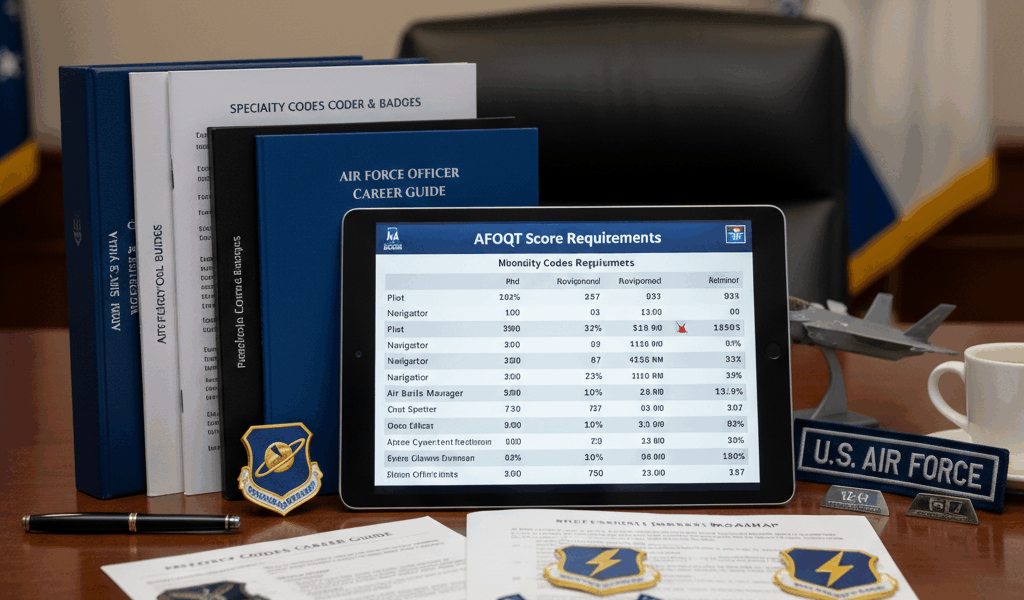
AFOQT Score Requirements by Career Path (2025)
AFOQT Score Requirements by Career Path has gotten complicated with all the conflicting information flying around. As someone who went through the AFOQT process and now coaches candidates through it, I learned everything there is to know about score requirements for different career paths. Today, I will share it all with you.
What You Need to Know First
The AFOQT is a multi-section standardized test used by the Air Force to evaluate officer candidates. It’s not just one test — it’s 12 subtests covering verbal skills, mathematics, spatial reasoning, aviation knowledge, and leadership judgment. Your scores combine into composite scores that determine which career fields you qualify for. Understanding this structure is the foundation of effective preparation.
Probably Should Have Led With This Section, Honestly
Your composite scores matter more than individual subtest scores. The Pilot composite feeds from specific subtests. The CSO composite pulls from different ones. Academic Aptitude combines verbal and quantitative measures. Before you study anything, figure out which composites matter for your career goals. That determines where you invest your limited study time. A future pilot should hammer instrument comprehension and aviation information. A non-rated officer candidate should focus on verbal and quantitative fundamentals.
The Verbal Sections
Verbal Analogies, Word Knowledge, and Reading Comprehension feed your Verbal composite. These are the most improvable sections on the test. Daily vocabulary building through apps like Anki, consistent reading across genres, and practice with word relationship patterns — these habits produce measurable score improvements within weeks. I built my vocabulary for two months before my test and it paid off significantly.
The Math Sections
Arithmetic Reasoning and Math Knowledge feed your Quantitative composite. The content doesn’t go beyond high school algebra and geometry. No calculus. No advanced statistics. But there’s no calculator allowed, so your mental math needs to be sharp. Practice doing computations by hand daily. Khan Academy covers everything you need for free. The math isn’t hard — the combination of no calculator and time pressure is what makes it challenging.
Aviation and Spatial Sections
Instrument Comprehension, Aviation Information, Block Counting, and Table Reading. These are the sections that make the AFOQT unique compared to other standardized tests. If you’re pursuing a pilot or CSO slot, these subtests carry enormous weight in your composites. Flight simulator practice is invaluable for instrument comprehension. The FAA Pilot’s Handbook covers aviation information. Spatial reasoning exercises improve block counting. Timed drills boost table reading speed.
Preparation Timeline
Six to eight weeks of structured daily study. That’s my recommendation for most candidates. Start with a diagnostic practice test to establish your baseline. Spend the first two weeks reviewing fundamentals. Weeks three and four on targeted weak-area practice. Weeks five and six on full-length timed practice tests. Final weeks on fine-tuning and test-day preparation.
Practice Tests Are Non-Negotiable
Take at least one full-length timed practice test per week during your study period. Practice tests build time management skills, reduce test-day anxiety, and reveal exactly where you need more work. The candidates I’ve coached who took regular practice tests consistently outperformed those who just reviewed material passively. Simulate real conditions every time — timed, quiet room, no phone, no breaks.
Score Targets and Competitive Benchmarks
That’s what makes understanding score targets endearing to us AFOQT coaches — they turn vague preparation into focused effort. Minimum qualifying scores are the 15th percentile Verbal and 10th percentile Quantitative. But minimums don’t win selections. Competitive pilot candidates need 70th+ percentile Pilot composites. CSO candidates should aim for 50th+ percentile. Non-rated candidates need balanced verbal and quantitative scores. Know your benchmarks and track your progress against them.
Test Day Execution
The night before: stop studying. Lay out your documents. Set alarms. Get seven-plus hours of sleep. Morning of: eat protein and complex carbs. Arrive thirty minutes early. Do breathing exercises to manage anxiety. During the test: maintain steady pacing, don’t get stuck on any single question, answer everything even if guessing, and trust the preparation you’ve put in.
The AFOQT is conquerable with the right preparation. Respect the test, prepare strategically, execute on test day, and you’ll earn scores that open doors to the Air Force career you want. The work starts now.
Recommended Drone Gear
ASA Remote Pilot Test Prep – $19.95
Complete prep for the FAA Part 107 exam.
Drone Pilot Log Book – $7.99
Track your flights and maintain compliance.
As an Amazon Associate, we earn from qualifying purchases.


Stay in the loop
Get the latest wildlife research and conservation news delivered to your inbox.