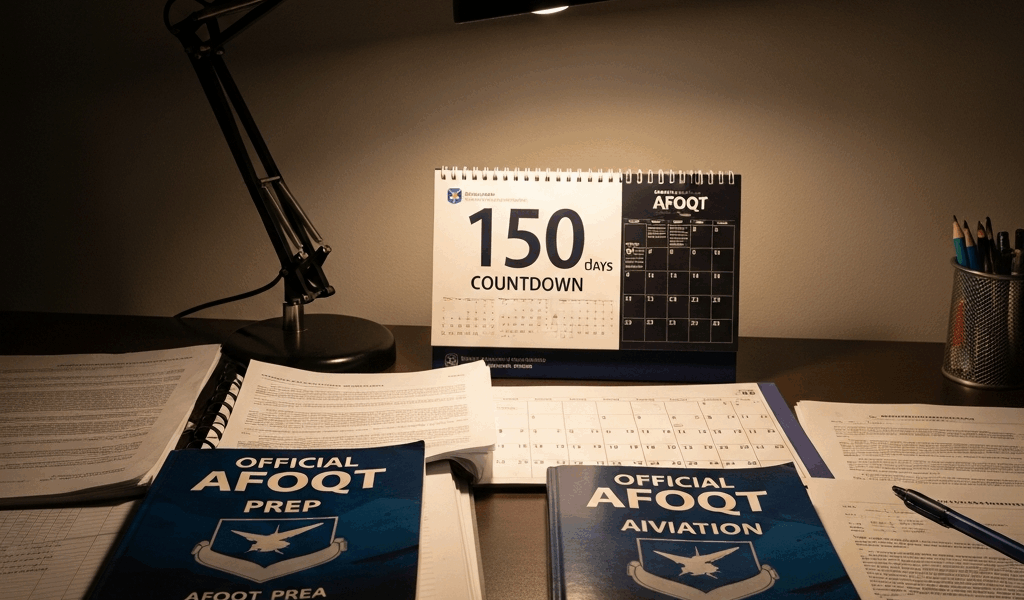
What the 150-Day Rule Actually Means for You
The AFOQT retesting situation has gotten complicated with all the misinformation flying around. So let me cut through it.
Your score came back low. Now you’re staring down a 150-day wall before you can sit in that chair again. Here’s what that actually means — and what it doesn’t.
The Air Force mandates a 150-day waiting period between attempts. You get two lifetime shots under normal circumstances. Two. Miss both and you’re done unless a waiver materializes — which happens rarely enough that building your entire strategy around one is a bad idea. The clock starts the day you tested, not the day your score report showed up in your inbox. Tested March 1st? You’re eligible August 29th. Write that date somewhere physical. Not your phone. A wall.
Branch-specific waivers do exist. Air Force, Navy, and Space Force each handle them differently, and your recruiter is technically supposed to know their branch’s policy. Most won’t bring it up unprompted. Ask directly: “Does my branch grant waivers for early retesting?” If they go quiet or say “probably not,” that’s actually useful data — waivers in your area are genuinely uncommon. Don’t burn emotional energy on a waiver application unless your recruiter gives you a real signal that it’s feasible. They usually don’t.
The 150 days isn’t a punishment. It’s a forced reset — designed to stop candidates from panic-testing every two months without actually changing anything. Treat it that way.
Diagnose Which Subtests Killed Your Composite
Probably should have opened with this section, honestly. I spent weeks drilling instrument comprehension tricks when my actual problem was math fundamentals. Lost time I couldn’t get back. Don’t make my mistake.
Panicked candidates almost always blame themselves broadly. That’s the wrong instinct. Your weakness is almost always specific — and finding it changes everything about how you spend the next 150 days.
The AFOQT produces two main composites: Pilot and Navigator. Pilot pulls from Instrument Comprehension, Block Counting, Math, Verbal Ability, and Situational Judgment. Navigator uses Verbal Ability, Math, Reading Comprehension, and Situational Judgment. They overlap, but the weighting shifts between them.
Here’s what most prep courses quietly skip over: Math and Verbal Ability feed into both composites. That makes them your highest-leverage targets by a wide margin. A 10-point gain in Math moves your Pilot and Navigator scores simultaneously. One subtest improvement there outweighs grinding Instrument Comprehension alone — by a lot.
Pull your detailed score report immediately if you haven’t already. Not the composite. The subtest breakdown. Most testing centers print it on-site; if yours didn’t, file a request through your recruiter today. You need to know whether you scored 15th percentile on Math while crushing Verbal, or whether you’re spread thin across everything. The fix looks completely different depending on the answer.
Targeted weakness in one or two subtests? Sixty days of focused work can move the needle. Weak across four or five areas? You need a different architecture entirely — less depth per subtest, more breadth, spread across the full window.
Build Your 150-Day Study Plan Around Your Weak Subtests
The 150 days breaks into four phases. This isn’t a suggestion. It’s structure — and structure is what separates candidates who improve by 20 points from ones who retake and land in the same spot.
So, without further ado, let’s dive in.
Phase One: Diagnosis and Baseline (Days 1–20)
Take a full practice test under timed conditions — no pausing, no peeking at answers mid-section. Get raw scores on each subtest. Identify your worst two or three areas, then buy one focused resource per weakness. For math, Khan Academy’s AFOQT math playlist (free, 40 videos, roughly 25 minutes each) beats generic prep books because it rebuilds fundamentals from scratch rather than teaching test tricks over a shaky foundation. For verbal, Barron’s AFOQT prep book runs $18 new, around $8 used — the vocabulary sections actually stick because they use context rather than raw memorization.
Phase Two: Focused Subtest Drilling (Days 21–90)
Commit 1.5 hours per weekday to your two worst subtests. One hour on the primary weakness, 30 minutes on your second. Not test simulation — pure drilling. Math goes through Khan Academy. Verbal goes through Anki flashcard decks (free desktop app, takes about 20 minutes to set up). Block Counting drills live on YouTube — search “AFOQT Block Counting tutorial” and you’ll find dedicated channels that break down spatial reasoning in ways textbooks never quite manage. Hit the same weak areas repeatedly until they stop feeling foreign.
Weekends are for full practice tests, timed, under proctored conditions if you can manage it. Score it the next morning — not immediately after. Then mark every error and classify it: speed error or comprehension error. Speed errors mean the drilling is working but you need to accelerate your pace. Comprehension errors mean you still don’t actually understand the concept underneath the question.
Phase Three: Timed Simulation (Days 91–140)
Stop drilling individual subtests. Shift entirely to full-length simulated tests — twice weekly, exact time limits, no stopping between sections. Use official Air Force sample questions from their recruiting site. Use Barron’s practice tests. Use the official test guide. The format matters as much as the content at this stage.
After each test, review every error immediately and write down the concept gap — not just “I got it wrong.” The difference between “I misread ‘not’ in the question stem” and “I don’t understand composite score calculations” determines what you do next. The first is a process error. The second is a content gap. They need different fixes.
Phase Four: Final Review and Confidence (Days 141–150)
One full practice test on Day 141. One on Day 147. That’s it. No new resources. No fresh material. Your brain doesn’t need more information at this point — it needs consolidation. Spend the final three days reviewing your error log from the previous four months. Then rest. Seriously. Rest is preparation.
This schedule assumes 1.5 to 2 hours on weekdays, 3 hours on weekends. Working full-time? Compress to weekends plus two 90-minute evening sessions during the week. The total math doesn’t shift much — you need roughly 200 hours to move a composite score 15 to 20 points. That’s the number. Plan around it.
Waiver Process and Who Actually Gets One
Waivers exist. Commanders grant them occasionally. But the reality is less encouraging than the rumor mill suggests.
A waiver request lands on your unit commander’s desk — not a centralized review board. No unit yet? Your recruiter submits it. Either way, waivers require documented exceptional circumstances: prior military service backed by strong evaluations, a GPA above 3.5, pilot-track certification from a civilian flight school, or letters of support from senior officers who know you by name. Not by face. By name.
All four factors in your file? Approval odds improve meaningfully. One or two? Still unlikely — possible, but unlikely. None? Use the 150 days and retest with a higher score. That’s what makes the retesting window endearing to candidates who actually use it well — it’s enough time to fix real problems if you take it seriously.
Most waivers are denied. Most commanders treat the two-attempt policy as exactly that — policy. Don’t build a contingency plan around a waiver. Build it around walking in the second time with a composite that doesn’t need one.
What to Do Today Before You Study Anything
Three actions. No debate about the order.
- Request your detailed score report if you don’t have the subtest breakdown yet. Email your testing center or recruiter today — not this week, today. Processing takes three to five business days, and you can’t diagnose anything accurately without it.
- Ask your recruiter about minimums. Get the actual composite score your target career field requires — Pilot, Navigator, ABM, whatever you’re chasing. Get the number in writing if at all possible. Recruiters occasionally oversell the difficulty or miscommunicate the target. You need the real figure before you set a goal.
- Pick one prep resource and order it this week. Khan Academy is free. Barron’s is $18. Either works. Don’t spend three weeks comparing prep courses on Reddit. Pick something and start. I’m apparently someone who over-researches everything, and that approach cost me two weeks of actual study time. Anki works for me while elaborate prep course systems never quite did.
The 150-day window feels enormous when you’re sitting at the beginning of it. It isn’t. It’s exactly enough time to fix targeted weaknesses — if you structure the work from day one rather than day forty.
You’ve already taken the test. You already know what that particular failure feels like. That knowledge is genuinely useful now. It tells you exactly what you’re fixing.
Use it.
Planning another test? Check the current AFOQT attempt limit, 90-day retest interval, waiver and superscoring rules before scheduling or choosing a study plan.




Stay in the loop
Get the latest afoqt prep updates delivered to your inbox.