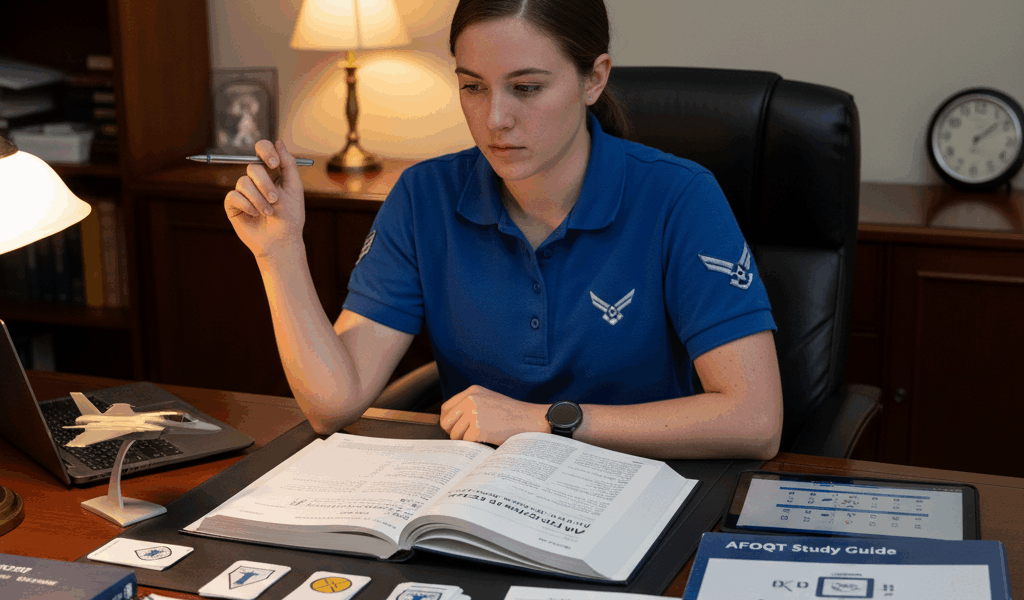
Understanding the AFOQT for Aspiring Pilots
AFOQT pilot test preparation has gotten complicated with all the conflicting advice flying around. As someone who went through the entire process — from cramming flashcards in my dorm room to actually sitting in that testing center with sweaty palms — I learned everything there is to know about the AFOQT pilot section. Today, I will share it all with you.

What is the AFOQT?
Let me break this down simply. The AFOQT — Air Force Officer Qualifying Test — is the standardized exam you need to pass if you want to become an officer in the United States Air Force. If you want to fly jets? You absolutely need this test. It’s been around since the 1950s, and the Air Force uses it to predict how well you’ll do in their training programs.
The test measures a bunch of different things. Verbal skills. Quantitative reasoning. Technical aptitude. It’s not just one big test either — it’s a collection of subtests that each measure something different. I remember thinking it was just going to be like the SAT. It’s not. It’s its own beast entirely.
AFOQT Test Components
Probably should have led with this section, honestly. Understanding what’s actually on the test is where most people should start. Here’s every subtest you’ll face, broken down the way I wish someone had explained them to me:
- Verbal Analogies: They give you word pairs and you figure out the relationship. Think “hot is to cold as up is to ___.” Except way harder than that. Getting good at recognizing patterns between words is what matters here.
- Arithmetic Reasoning: Word problems. Pure and simple. You’re solving math scenarios using basic operations — addition, subtraction, multiplication, division. The math isn’t advanced, but the time pressure makes it tricky.
- Word Knowledge: Vocabulary. They show you a word and you pick the synonym. I spent weeks building my vocabulary with apps and honestly, it paid off big time on test day.
- Mathematics Knowledge: This one tests your grasp of math concepts. Algebra, geometry, that kind of thing. If you paid attention in high school math, you’ve got a head start.
- Instrument Comprehension: Now we’re getting into pilot territory. You read aircraft instruments and determine the aircraft’s position and heading. This is where future pilots really need to shine.
- Table Reading: Speed and accuracy. They throw tables at you and you need to pull information out fast. Pattern recognition and quick processing are everything.
- Block Counting: Spatial awareness. You look at 3D block formations and count how many blocks touch a specific one. Sounds simple until the clock is ticking.
- Aviation Information: General aviation knowledge. How do wings generate lift? What are the primary flight controls? If you’ve been around planes, this section feels like a conversation with a buddy.
- Rotated Blocks: Mental rotation of 3D objects. They show you a shape and you figure out which option matches it when rotated. My brain hurt after practicing these, but it got easier.
- General Science: Earth science, physics, biology — the basics. Nothing crazy advanced, but you need a solid foundation across the sciences.
How AFOQT Scoring Works
Here’s something that trips up a lot of candidates. You don’t get one single AFOQT score. Instead, they calculate composite scores from different combinations of subtests. Each composite corresponds to specific career fields in the Air Force. I’ve seen people ace sections they didn’t even need for their career path while bombing the ones that mattered most. Don’t let that be you.
- Verbal Composite: Pulls from verbal analogies and word knowledge scores. If you’re going into a role that involves leadership communication or briefings, this one matters a lot.
- Quantitative Composite: Combines arithmetic reasoning and math knowledge. Technical and scientific career fields key in on this composite heavily.
- Academic Aptitude Composite: A blend of verbal and quantitative measures. Think of it as your overall academic horsepower indicator.
- Pilot Composite: This is the big one for aspiring aviators. It pulls from instrument comprehension, aviation information, and several other pilot-relevant subtests. I obsessed over this score, and if you want to fly, you should too.
- Navigational Composite: Focuses on navigation skills. Critical if you’re looking at combat systems officer or navigator career fields.
Preparing for the AFOQT
Look, I’m not going to sugarcoat it. You need to study. But you need to study smart, not just hard. I watched guys spend three months grinding through random practice problems with no strategy. They didn’t do as well as the people who spent six weeks with a real plan. Here’s what actually works:
- Study Materials: Get an official AFOQT prep book. Seriously. The ones that mirror the actual test format are gold. I used two different guides and cross-referenced them to make sure I wasn’t missing anything.
- Practice Tests: Take full-length, timed practice tests. Not just random questions — the full test, under real conditions. Time management is half the battle on test day, and you need to build that muscle.
- Review High School Math and Science: Dust off those algebra and geometry concepts. Go back to the periodic table. Review basic physics. This isn’t about learning new material — it’s about reminding your brain what it already knows.
- Stay Current on Aviation: Read aviation news. Watch YouTube videos about flight mechanics. The aviation information subtest rewards people who genuinely engage with the subject, not just memorize facts.
- Build Your Vocabulary Daily: Download a vocabulary app. Read books outside your comfort zone. Every new word you learn is a potential free point on the word knowledge section.
Test Registration and Logistics
The administrative side of the AFOQT isn’t hard, but you need to know the rules. I’ve seen candidates show up unprepared for the logistics and it threw their whole day off. Don’t let paperwork be the thing that sinks you.
- Eligibility: The AFOQT is for people pursuing an officer commission in the U.S. Air Force. College students and graduates make up most of the test-takers. ROTC cadets, OTS candidates — that’s the crowd you’ll be sitting with.
- Registration Process: You register through your Air Force recruiter or ROTC detachment. Make sure all your documentation is squared away before you even start the registration process. Nothing worse than getting delayed over paperwork.
- Test Frequency: Here’s the kicker — you only get two shots at this test in your lifetime. Two. And there’s a mandatory 150-day waiting period between attempts. So when I say study hard the first time around, I mean it.
- Day of the Test: No calculators. Strict time limits on every section. Follow every instruction the test administrator gives you. Show up early, bring the required ID, and keep your head in the game.
Significance of the AFOQT
That’s what makes the AFOQT pilot composite endearing to us future aviators — it’s literally the key that unlocks the door to the cockpit. Your pilot composite score carries enormous weight when selection boards review your package for Undergraduate Pilot Training. A strong score opens doors. A weak one closes them, sometimes permanently.
Every single point matters. I’ve talked to officers who missed pilot slots by razor-thin margins because their AFOQT scores weren’t competitive enough. Your scores determine eligibility not just for pilot roles but also for weapons systems officer positions and other rated career fields. This test is the foundation that everything else builds on.
The AFOQT isn’t just another standardized test you take and forget about. It’s the gateway to your entire Air Force aviation career. I tell every candidate I work with the same thing: treat this test like your future depends on it, because it does. Put in the work now and you’ll thank yourself when you’re strapping into a cockpit instead of wondering what could have been.
Recommended Drone Gear
ASA Remote Pilot Test Prep – $19.95
Complete prep for the FAA Part 107 exam.
Drone Pilot Log Book – $7.99
Track your flights and maintain compliance.
As an Amazon Associate, we earn from qualifying purchases.




Stay in the loop
Get the latest wildlife research and conservation news delivered to your inbox.