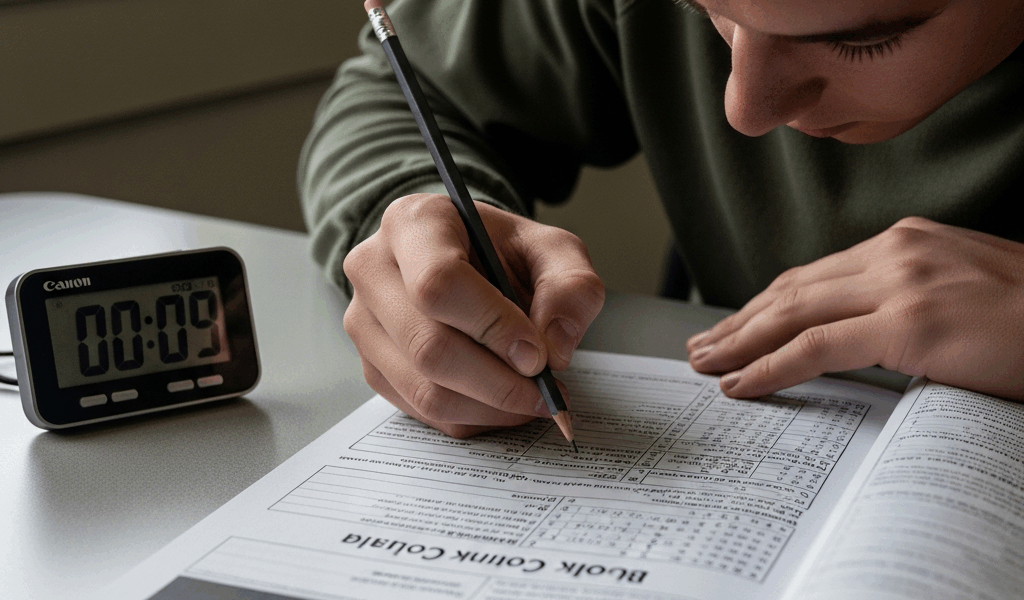
AFOQT Block Counting — Strategy That Actually Works in 9 Seconds
The AFOQT block counting section broke me the first time I sat down with a practice test. I had studied for weeks, felt confident walking in, and then watched my composure dissolve when I realized what 30 questions in 4.5 minutes actually means in practice. That is nine seconds per question. Not nine seconds to think carefully and double-check your work. Nine seconds total — read, count, bubble, move. Block-counting performance improves by using a consistent visual method rather than relying on speed or intuition alone. It had everything to do with having a system I ran automatically, the same way every single time, until my hands were filling in answers before my brain had fully processed the image.
Probably should have opened with this section, honestly — but before we get into the method itself, you need to understand why the time constraint changes everything about how you should prepare.
The 9-Second Rule — Why Speed Matters More Than Accuracy
Most people approach block counting like a puzzle. They look at the image, think about it from different angles, second-guess themselves, and move on. That approach works fine when you have two minutes per question. You have nine seconds. That is not a metaphor for “be quick.” That is the literal math.
30 questions. 4.5 minutes. 270 seconds total. 9 seconds each.
Here is what nine seconds actually feels like — set a timer right now and count to nine. That is it. That is everything you have to look at a three-dimensional block arrangement, count how many blocks are touching one specific labeled block, select from five answer choices, and mark your answer sheet. If you spend twelve seconds on question four, you have already borrowed time you do not have.
The implication is uncomfortable but important. Accuracy is not your primary goal. Throughput is. A test-taker who answers all 30 questions with 80% accuracy outscores someone who gets 20 questions perfectly right and leaves 10 blank. The scoring on this section does not penalize wrong answers on the current AFOQT format, which means your expected value from a random guess is always positive. Leaving questions blank is the only unambiguously wrong move.
Frustrated by my first practice scores hovering around 60%, I started treating this section like a timed athletic drill rather than an academic exercise. I printed 200 practice questions from the Barron’s AFOQT Study Guide (the $18.99 edition, sixth printing) and ran them with a phone stopwatch, forcing myself to bubble an answer — any answer — before the nine-second alarm. Speed first. Accuracy will follow the system. The system had to become muscle memory.
That is the real preparation shift. You are not learning how to count blocks. You are training a counting reflex.
The Systematic Count Method
Every block in these diagrams has six possible faces — top, bottom, left, right, front, and back. The question always asks how many other blocks are touching the labeled block. Your job is to check all six faces, one at a time, in the same order, every single time. Not the order that feels natural. The same order. Always.
My order was: Top → Bottom → Left → Right → Front → Back. Some people prefer front-to-back first. It genuinely does not matter which order you choose. What matters is that you never deviate from it, because the moment you start improvising mid-problem is the moment you lose count or double-count a touching block.
Walking Through the Six-Face Check
Take the target block — the one with the number or letter label on it. Now mentally ask six yes/no questions in rapid sequence:
- Top face — Is there a block sitting directly on top of this one? Yes = 1, No = 0.
- Bottom face — Is this block resting on another block, or is it on the ground? If on a block, Yes = 1.
- Left face — Is there a block flush against the left side?
- Right face — Same check on the right side.
- Front face — Is there a block in front of it, visible or implied by the row?
- Back face — Is there a block directly behind it in the same stack or row?
Add the six yes/no answers. That number is your count.
The most common mistake — and I made this constantly for the first two weeks — is forgetting to check the bottom face. When a block is sitting in the middle of a stack, the block beneath it counts as a touching block. It seems obvious written out like this. Under time pressure with a ticking stopwatch, you will skip it if it is not hardwired into your sequence.
The Hidden Block Problem
Some configurations hide blocks behind other blocks. The front-row blocks are always visible, but the back rows can be partially or fully obscured. This is intentional. The test writers know that rushed test-takers will only count what they can see.
The rule here is simple: if the arrangement shows a block in a position that requires support, assume the supporting block exists even if you cannot see it directly. A block floating in mid-air is not a valid configuration. If you see a block on the second level and nothing is shown beneath it at ground level, that ground-level block is there — you just cannot see it. Count it.
Visual practice with actual 3D block diagrams matters more here than any verbal explanation I can give. The Kaplan Officer Candidate tests book (blue spine, roughly $22 at most base exchanges) has 40 pages of these diagrams specifically, and the answer key explains each count step by step. Work those problems with the six-face method until the sequence feels like reading — automatic, below conscious thought.
What Counts as Touching
Only face-to-face contact counts. Blocks that share a corner do not count. Blocks that share an edge do not count. Full face contact only. This eliminates a lot of ambiguous cases and is the rule the AFOQT strictly follows — so internalize it early and never second-guess it during the test.
When to Guess and Move On
There are three block configurations that will eat your clock alive if you let them. Recognize them fast and execute the skip-and-guess protocol without hesitation.
Configuration one — deeply buried interior blocks in large 3D grids, typically 4x4x4 arrangements where the target block is somewhere in the middle with no visible faces. These take 20 to 30 seconds to mentally reconstruct. Not worth it.
Configuration two — L-shaped or irregular staircase arrangements where it is genuinely unclear whether two blocks are in the same plane or different planes. The diagram perspective can make this ambiguous, and the answer options spread across a wide range.
Configuration three — any question where you have already spent what feels like five to six seconds and still have not started counting. That hesitation response is a signal. The problem has something confusing about it that your brain flagged. Trust the flag, guess, and move.
The Middle-Value Guessing Rule
When you guess on this section, do not guess randomly. The AFOQT answer choices for block counting typically range from 1 to 6 touching blocks. Statistically, the correct answers cluster around 3 and 4 far more often than 1 or 6. Extreme values — 1 touching block or 6 touching blocks — are possible but rare. When you are guessing blind, choose 3 or 4. Over 10 forced guesses, this tendency improves your expected score by roughly one additional correct answer compared to random selection across all five choices.
I kept a small sticky note on my practice booklet that just said “3 or 4” for the first month until it became automatic. Sounds trivial. It genuinely moves the needle.
Managing the Skip-and-Return Temptation
Do not skip and return. Mark a guess immediately, circle the question number lightly in your test booklet if that is allowed in your test setting, and keep moving. Returning eats more time than the skip saved, and time debt compounds fast in a 4.5-minute section. The only exception is if you finish the section with 30 seconds to spare — in practice, this will not happen on your first several run-throughs, but it becomes achievable once the system is fully automatic.
The six-face sequence, the hidden block assumption rule, and the middle-value guess protocol are the entire system. Three components. Nothing else. Run it on 300 practice problems before your test date, time yourself ruthlessly, and you will watch your score climb in a way that feels almost unfair once it clicks.
Nine seconds is enough time. It just has to be the right nine seconds.




Stay in the loop
Get the latest afoqt prep updates delivered to your inbox.