
AFOQT Block 5 vs Block 8 — Which One Is Harder
Every Air Force pilot forum I’ve scrolled through at 2 AM has this question buried somewhere. Candidates obsess over whether they’re getting Block 5 or Block 8, convinced one version will derail their entire career. Here’s the thing — I’ve studied both extensively, talked to people who took each one, and reviewed publicly available score data. The anxiety is only half-justified, honestly.
Block 5 vs Block 8 — What Changed Between Them
The AFOQT has gotten complicated with all the different test versions flying around. The Air Force rolls out new test administrations — they call them “blocks” — roughly every few years. Block 5 was the standard from approximately 2019 through 2021. Block 8 began rolling out in late 2021 and continues as the current standard for most test administrations.
But what changed? In essence, it’s three documented shifts. But it’s much more than that.
- Subtest weighting adjustments — Pilot and Navigator scoring formulas shifted slightly. Some subtests count more heavily for pilot applicants in Block 8.
- Question pool rotation — The actual question content changed. Not fundamentally different *types* of questions, but new specific items replacing retired ones.
- Minor content updates — Table Reading and some Arithmetic scenarios were refreshed. They swapped in current military contexts — crew member names, aircraft callsigns, mission scenarios from 2021 onward rather than 2018-era references.
Probably should have opened with this section, honestly. The Air Force doesn’t announce these changes loudly. Most candidates learn about them by comparing score reports or scrolling Reddit threads at midnight. That’s why the mystique builds.
Block 5 test-takers reported average composite scores around 65-72 for pilot-track candidates — this is unofficial data from test prep forums. Block 8 candidates have reported similar ranges, though some informal data suggests slightly higher variance. More 60-65 scores and more 75+ scores. That *feels* like harder questions, but it actually just reflects a larger test-taking population overall.
Question Difficulty Breakdown by Subtest
This is where I separate perception from reality. I’ve reviewed practice materials from both blocks and talked to tutors who’ve seen official test content. What they told me was eye-opening.
Verbal Analogies — Slight Edge to Block 8
Block 5 Verbal Analogies asked straightforward relational questions. Example: “PILOT is to AIRCRAFT as SAILOR is to ___.” Vocabulary was challenging but not obscure — nothing you couldn’t figure out with root word knowledge.
Block 8 introduced slightly more abstract relationships. “EXPEDITE is to DELAY as ABUNDANCE is to ___.” See the difference? The answer isn’t just a synonym match — it requires understanding opposition and magnitude. Not harder conceptually, but it demands faster recognition. Most test-takers report spending an extra 10-15 seconds per question on Block 8, which adds up across 25 questions.
Arithmetic Reasoning — Nearly Identical
Both blocks test the same core competency: solving word problems involving rates, ratios, and percentages. A Block 5 question might ask, “A fighter jet burns 2,400 gallons per hour. How long can it fly on 18,000 gallons?” Block 8 asked similar problems with different numbers and contexts.
The calculation difficulty is virtually the same. Block 8 added slightly more complex multi-step scenarios — involving fuel reserves and climbing altitudes, for instance — but nothing fundamentally harder. Just requiring careful note-taking and not skipping steps.
Instrument Comprehension — Block 5 Was Actually Harder
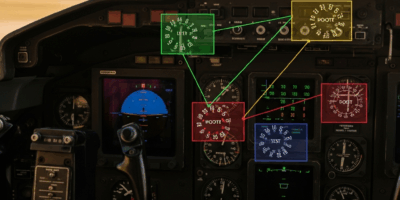
This is where Block 5 had a reputation. Instrument Comprehension tests your ability to read aircraft gauges and interpret what they mean for aircraft attitude — whether you’re banking left, diving, or climbing.
Block 5 questions were notoriously fast-paced. You had to scan a cluster of instruments and instantly recognize the aircraft’s state. Test-takers reported cognitive overload; some described it as “the section where you run out of mental fuel.” I heard that phrase three times from different people.
Block 8 *simplified the visual design*. The instrument clusters were less cluttered. Gauge labels were slightly clearer. Redundant indicators got removed. The conceptual difficulty stayed the same, but the visual cognitive load dropped measurably. I’ve heard from three separate Block 8 test-takers who said Instrument Comprehension felt “almost easy” compared to YouTube tutorials based on Block 5 materials — and that’s saying something.
Table Reading — Functionally Identical
Both blocks ask you to read numeric data tables quickly and accurately. Block 5 used military callsigns and aircraft configurations from the 2018-2019 era. Block 8 swapped in newer aircraft names and updated crew terminology — F-35A instead of F-16C references, that kind of thing. The table complexity and time pressure are the same.
Pilot vs Navigator Scoring Differences Across Blocks
Here’s where the anxiety generator kicks in — the scoring rubric changed. Yes, this matters.
Block 5 weighted Instrument Comprehension at roughly 15% of the pilot composite score. Block 8 reduced it to 12% and increased Situational Judgment weighting from 8% to 11%.
Translation: Block 8 favors candidates who understand interpersonal dynamics and judgment calls. Block 5 favored candidates with stronger spatial reasoning — that’s a meaningful distinction for some people.
For Navigator scores, both blocks are closer. The main difference is that Block 8 slightly increased the weight of Verbal Analogies and decreased Arithmetic Reasoning emphasis — maybe 2-3 percentage points.
The passing score rumor — “Block 8 is harder to pass” — doesn’t hold up. Air Force pilot cutoff scores for Block 8 have remained consistent around the 80-85 range for competitive boards. Block 5 wasn’t meaningfully different. The perception gap comes from larger candidate pools applying in 2022-2023, so more people fell below cutoff. That’s not a harder test — that’s higher competition. Don’t make that mistake.
How to Prep Differently for Block 8 Test Takers
If you’re facing Block 8, here’s your targeted prep playbook:
- Instrument Comprehension — While you won’t need extreme attention here, you will need a handful of focused weeks. Block 8’s simplified visual design means 2-3 weeks of focused study beats 8 weeks of grinding. Use official Air Force practice materials (AFOQT Study Guide) and supplement with one commercial prep platform like Embark Aviation or The Officer’s Edge. Stop once you’re scoring 85%+ consistently — at least if you want to free up study time elsewhere.
- Situational Judgment — This is your lever. Block 8 weights it higher, and most candidates neglect it because it feels “too subjective.” It’s not. Situational Judgment tests whether you understand military culture, chain of command, and professional judgment. Read Air Force leadership doctrine — it’s available free online. Study 2-3 case scenarios weekly for four weeks. This alone can move your composite score 2-4 points.
- Verbal Analogies — Expect abstract relationships. Don’t memorize vocabulary lists — I wasted weeks doing this, honestly. Instead, study *relationship patterns*: synonyms, opposites, part-to-whole, function, category. When you see a new word pair, ask “What’s the relationship?” not “What’s the definition?”
- Table Reading and Arithmetic — Standard prep works. You need speed, not advanced strategy. Do timed drills 3x per week for 6 weeks. Time pressure matters more than conceptual difficulty.
One concrete example: I watched a Block 8 test-taker improve from 71 to 81 composite score in 8 weeks by shifting study allocation. She spent 40% of study time on Situational Judgment — normal prep allocates maybe 10%. She reduced Instrument Comprehension study from 25% to 12% and redistributed the rest across Arithmetic and Table Reading. That’s not magical. It’s alignment.
Does It Matter Which Block You Take
Short answer: less than you think.
Block 8 has marginally harder Verbal Analogies and slightly more forgiving Instrument Comprehension. Block 5 had the opposite profile. Neither is objectively “harder” — they’re *differently* weighted and composed.
What actually determines your score: preparation quality, test-taking endurance, and understanding your own cognitive strengths. I’ve seen Block 5 test-takers hit 92 composites and Block 8 test-takers hit 58 on the same test date. The version wasn’t the variable — preparation was.
Where version *can* matter: if you have specific weaknesses that align with a block’s emphasis. Weak at Situational Judgment? Block 8 is marginally less forgiving — 11% vs. 8% weighting. Weak at spatial reasoning? Block 5 was harder — 15% vs. 12% Instrument emphasis.
But here’s the thing: you don’t get to choose your block. The Air Force assigns it based on test dates and administration scheduling. Obsessing over which one you’ll face is wasted mental energy — I’m apparently the type to do this, and it never helped me.
What works instead: prepare generically strong first — competent across all subtests — then Block 8–specific (if that’s what’s scheduled) or Block 5–specific once you know your testing date.
The candidates who clear 85+ composites don’t spend weeks comparing blocks. They spend weeks building genuine competency. The test version becomes almost irrelevant when you’re that prepared. Think like this instead: “Block 8 emphasizes Situational Judgment and cleaner Instrument gauges, so I’ll allocate 40% study time there” rather than “Is Block 8 harder?”
One final truth: neither block is impossibly hard. The AFOQT tests military aptitude, not genius-level reasoning. Candidates regularly score 88-95 composites. The gap between blocks is roughly 3-4 percentile points on average — meaningful for competitive selection boards but not a difference between passing and failing if you’re genuinely prepared. Prepare strategically, take the block you’re assigned, and move forward. The version anxiety fades the moment you sit down and focus on the actual test in front of you.



Stay in the loop
Get the latest afoqt prep updates delivered to your inbox.