
How Hard is the AFOQT? Complete Difficulty Breakdown (2026)
The Air Force Officer Qualifying Test (AFOQT) is one of the most important exams you’ll take in your journey to becoming an Air Force officer. If you’re wondering “how hard is the AFOQT?” – you’re not alone. Thousands of aspiring officers ask this question every year. The honest answer: it’s challenging but definitely passable with proper preparation.


Quick Answer: AFOQT Difficulty Rating
On a scale of 1-10, most test-takers rate the AFOQT difficulty between 6-7. It’s harder than the SAT or ACT but easier than specialized graduate exams like the LSAT or MCAT. The AFOQT is designed to be challenging enough to identify capable officer candidates while still being achievable for well-prepared applicants.
What Makes the AFOQT Challenging?
1. Time Pressure
The single biggest challenge most test-takers face is time management. The AFOQT consists of 12 subtests completed over approximately 5 hours, with strict time limits for each section. Many questions are straightforward, but you have very little time per question.
For example:
- Verbal Analogies: 25 questions in 8 minutes (19 seconds per question)
- Math Knowledge: 25 questions in 22 minutes (53 seconds per question)
- Reading Comprehension: 25 questions in 38 minutes (1.5 minutes per question)
Unlike the SAT where you can skip and return to questions, the AFOQT doesn’t allow you to go back once you move forward. This adds pressure to make quick, confident decisions.
2. Breadth of Content
The AFOQT tests a wide range of knowledge areas in a single sitting:
- Verbal (analogies, reading comprehension)
- Math (algebra, geometry, arithmetic reasoning)
- Aviation concepts (even if you’ve never flown)
- Spatial reasoning and visualization
- Instrument comprehension
- Block counting
- Table reading
- Aviation information
- Physical science
You need to be proficient across all these domains. Being strong in verbal but weak in math won’t be enough – you need balanced scores.
3. High Stakes
The AFOQT is a one-shot deal for many applicants. While you can retake it, there’s a 150-day waiting period between attempts, which can significantly delay your commissioning timeline. This pressure makes the test feel harder than it objectively is.
4. Aviation-Specific Sections
Even if you have zero flight experience, you’re tested on aviation concepts, instrument reading, and aircraft knowledge. These sections are particularly challenging for non-pilots and require dedicated study.
AFOQT Difficulty by Section
Verbal Analogies – Difficulty: 6/10
These questions test your vocabulary and ability to see relationships between words. If you’re a strong reader, this section is manageable. The main challenge is the tight time limit – only 19 seconds per question.
Example question type: PUPPY is to DOG as KITTEN is to ___
Arithmetic Reasoning – Difficulty: 7/10
Word problems testing your ability to translate real-world scenarios into mathematical equations. These require both math skills and reading comprehension under time pressure.
Math Knowledge – Difficulty: 7/10
Covers algebra, geometry, and arithmetic. Content is roughly high school level, but the time pressure and need to recall formulas you haven’t used in years makes it challenging.
Reading Comprehension – Difficulty: 5/10
Standard reading passages with questions. If you can read quickly and retain information, this is one of the easier sections. However, the passages can be dry (military regulations, technical topics).

Situational Judgment – Difficulty: 6/10
Tests your decision-making in hypothetical officer scenarios. No “right” answer per se, but some responses are clearly better than others. Challenging because it tests judgment and leadership intuition.
Physical Science – Difficulty: 7/10
Covers basic physics and chemistry. Difficulty varies greatly based on your science background. For liberal arts majors, this can be one of the hardest sections. For STEM majors, it’s relatively easy.
Table Reading – Difficulty: 4/10
Pure speed test. You locate values in a table as quickly as possible. Not intellectually challenging, but requires intense focus and quick visual scanning.
Instrument Comprehension – Difficulty: 8/10
Shows aircraft instruments and asks you to determine aircraft attitude (pitch, roll, heading). Very challenging for non-pilots. Requires spatial reasoning and understanding of flight instruments.
Block Counting – Difficulty: 6/10
3D visualization questions. You see a stack of blocks and determine how many blocks touch a specific block. Challenging for people who struggle with spatial reasoning.
Aviation Information – Difficulty: 8/10 (for non-pilots)
Tests knowledge of aircraft components, flight principles, and aviation terminology. Extremely difficult without prior study or flight experience. Easier if you’ve taken ground school or have a pilot’s license.
General Science – Difficulty: 6/10
Broad coverage of biology, chemistry, physics, and earth science. High school level content, but the breadth makes it challenging.
How Does the AFOQT Compare to Other Tests?
AFOQT vs. SAT/ACT
The AFOQT is notably harder than the SAT or ACT for several reasons:
- Stricter time limits
- More diverse content areas (aviation, instruments, situational judgment)
- Higher stakes (affects career path)
- No ability to skip and return to questions
If you scored above 1200 on the SAT or 26 on the ACT, you have the baseline ability to do well on the AFOQT with proper preparation.
AFOQT vs. ASVAB
The AFOQT is significantly harder than the ASVAB (Armed Services Vocational Aptitude Battery). The AFOQT is specifically designed for officer selection and includes more complex reasoning, aviation knowledge, and time pressure.
AFOQT vs. GRE/GMAT
The AFOQT is generally considered easier than the GRE or GMAT. Graduate school entrance exams test more advanced reasoning and have adaptive difficulty. However, the AFOQT’s breadth and aviation sections make it uniquely challenging.
AFOQT Pass Rates and Statistics
The Air Force doesn’t publish official pass rates, but based on recruiter data and test-taker reports:
- ~70-80% of first-time test-takers achieve qualifying scores for some officer positions
- ~40-50% achieve scores competitive for pilot slots (typically 70+ pilot composite score)
- ~20-30% need to retake the exam to improve their scores
These statistics show that while most prepared candidates pass, achieving highly competitive scores (especially for pilot positions) is challenging.
What Scores Do You Need?
The AFOQT is scored in percentiles (1-99) across five composite scores:
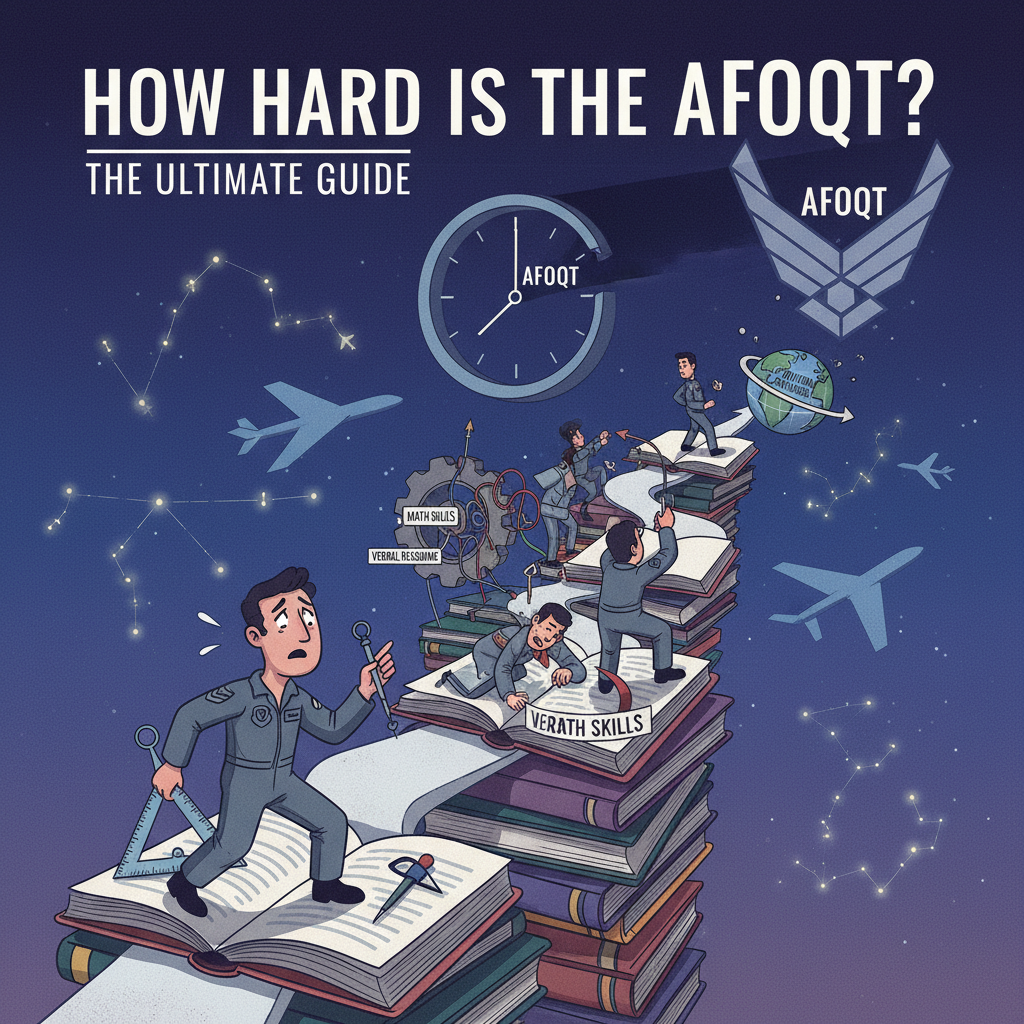
- Pilot: Minimum 10-25 (varies by board), competitive 70+
- Navigator-Technical: Minimum 10-25, competitive 60+
- Academic Aptitude: Minimum 15, competitive 60+
- Verbal: Minimum 15, competitive 50+
- Quantitative: Minimum 10, competitive 50+
Reality check: Meeting minimums doesn’t guarantee selection. For competitive positions like pilot, you need scores well above minimums. The average selected pilot candidate scores in the 70-80 range on pilot composites.
How to Know If You’re Ready
You’re probably ready for the AFOQT if you can:
- Consistently score 80%+ on practice tests
- Complete timed practice sections within time limits
- Identify aircraft types and understand basic flight principles
- Solve algebra and geometry problems quickly without a calculator
- Read and interpret aircraft instruments correctly
- Perform mental math efficiently
Study Timeline: How Long to Prepare?
Most successful test-takers follow this timeline:
- 6-8 weeks: Ideal for most applicants with average academic background
- 3-4 weeks: Minimum for those with strong academic skills and recent standardized test experience
- 12+ weeks: Recommended if you struggle with math or haven’t studied these subjects in years
Study hours: Plan for 60-100 total study hours, focusing heavily on your weak areas and the aviation-specific sections.
Tips to Make the AFOQT Easier
1. Focus on Weak Areas
Don’t spend equal time on all sections. If you’re strong in verbal but weak in aviation, spend 70% of your study time on aviation. The test is pass/fail on each section – shoring up weak areas is more valuable than perfecting strong ones.
2. Master the Aviation Sections Early
Aviation Information and Instrument Comprehension are the most “learnable” sections. Unlike math skills that take time to rebuild, aviation knowledge can be memorized in a few weeks of focused study.
3. Practice Under Time Pressure
Take at least 3-5 full-length practice tests under actual time constraints. This is the single most important preparation strategy.
4. Use Quality Study Materials
Invest in a good AFOQT prep book (Trivium, Barron’s, or Accepted Inc. are recommended). Free online materials vary wildly in quality.
5. Build Mental Stamina
The test is 5+ hours long. Practice maintaining focus and performance over long periods. Take practice tests at the same time of day as your actual test.
Common Mistakes That Make It Harder
- Waiting until the last minute: Cramming doesn’t work for the AFOQT’s breadth
- Ignoring aviation sections: These sections heavily weight pilot scores
- Not practicing time management: Knowing content isn’t enough if you can’t finish
- Retaking without significant prep: Your score won’t improve much without addressing weaknesses
- Perfectionism: You don’t need 99s – competitive scores are achievable without perfection
The Bottom Line
The AFOQT is challenging but not insurmountable. With 6-8 weeks of focused preparation, most candidates can achieve competitive scores. The difficulty comes from:
- Time pressure on every section
- Breadth of content (verbal, math, science, aviation, spatial)
- Aviation-specific knowledge requirements
- High-stakes nature of the exam
However, the AFOQT is designed to be passable by motivated, well-prepared candidates. It’s not trying to trick you or test obscure knowledge – it’s assessing whether you have the foundational skills to succeed as an Air Force officer.
If you’re willing to put in the study time, stay disciplined with practice tests, and address your weak areas systematically, you can absolutely achieve the scores you need. Thousands of officers before you have passed this test – and you can too.

Next Steps
- Take a diagnostic practice test to identify weak areas
- Create a 6-8 week study schedule
- Invest in quality prep materials
- Focus 50% of study time on aviation sections (if applying for rated positions)
- Take at least 3 full-length timed practice tests
- Schedule your test date once you’re consistently scoring above your target
The AFOQT is hard, but it’s absolutely achievable with the right preparation strategy. Good luck with your preparation – the Air Force needs dedicated officers like you!



Stay in the loop
Get the latest wildlife research and conservation news delivered to your inbox.