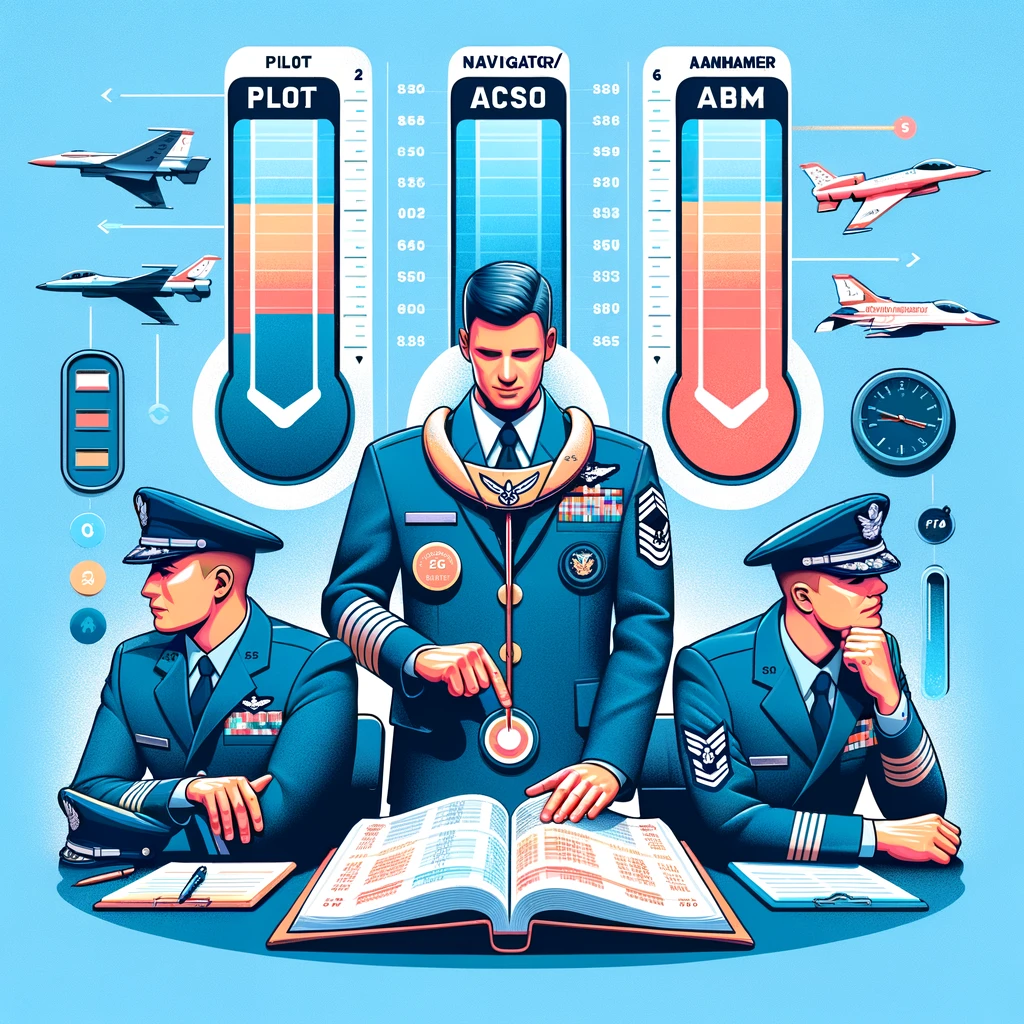
The minimum AFOQT scores for Air Force line-officer commissioning are 15 Verbal and 10 Quantitative. Rated applicants must also earn at least 25 in the composite for their requested training: Pilot 25 for pilot or remotely piloted aircraft training, Combat Systems Officer 25 for CSO training, or Air Battle Manager 25 for ABM training.
These are qualifying floors, not guaranteed selection scores. The Department of the Air Force does not publish one universal “competitive score” because selection depends on the commissioning source, career field, board, applicant pool, and the rest of the candidate’s record.
Current AFOQT minimum-score chart
| Applicant path | Verbal | Quantitative | Rated composite |
|---|---|---|---|
| Non-rated line-officer commissioning | 15 | 10 | Not applicable |
| Pilot, including remotely piloted aircraft | 15 | 10 | Pilot 25 |
| Combat Systems Officer | 15 | 10 | CSO 25 |
| Air Battle Manager | 15 | 10 | ABM 25 |
The January 2025 editions of DAFMAN 36-2664 and DAFMAN 36-2032 publish these standards. Program instructions can impose additional requirements, and waiver authority exists under current policy. Confirm the rules for your accession source with your recruiter, testing office, or AFROTC detachment before making an application decision.
Is there one overall passing AFOQT score?
No. The AFOQT does not produce a single pass/fail total comparable to a classroom percentage. It reports composite scores for different aptitude areas. Commissioning eligibility depends on meeting the applicable minimum in every required composite.
For example, a non-rated applicant who earns Verbal 60 but Quantitative 9 has not met the standard, even though one score is high. A pilot applicant must meet Verbal 15, Quantitative 10, and Pilot 25; a high Pilot score does not replace a deficient Verbal or Quantitative score.
How AFOQT composite scores work
Current AFOQT composites are reported on a 1-to-99 percentile scale. A percentile describes performance relative to the test’s reference population; it is not the percentage of questions answered correctly. A score of 60 therefore does not mean “60 percent correct.”
The official score report includes six composites:
- Pilot
- Combat Systems Officer (CSO)
- Air Battle Manager (ABM)
- Academic Aptitude
- Verbal
- Quantitative
The rated composites serve different classifications. A pilot applicant needs the Pilot minimum; CSO and ABM scores do not substitute for it. Academic Aptitude is useful information, but the minimum-standards table specifies Verbal, Quantitative, and the applicable rated composite rather than a universal Academic Aptitude cutoff.
Minimum score versus competitive score
A minimum score answers only whether the candidate meets a published testing floor. It does not predict selection. Officer selection can also consider education, GPA, leadership, work history, recommendations, physical qualification, component needs, and other program-specific factors.
Be cautious with websites that publish unsupported claims such as “every competitive pilot needs an 80” or a fixed average score for all Officer Training School applicants. Applicant pools and selection needs change, and the Air Force’s minimum-standards table does not establish those numbers as selection cutoffs.
A responsible target is therefore not a made-up universal benchmark. First clear every official minimum comfortably. Then ask the office managing your specific application what recent board guidance, if any, it can provide. Use practice performance to direct study, not to guarantee a selection outcome.
Minimum pilot AFOQT and PCSM requirements
Pilot and remotely piloted aircraft applicants need at least 25 in the AFOQT Pilot composite under the current minimum table. DAFMAN 36-2032 also states that pilot applicants from all accession sources must have a minimum Pilot Candidate Selection Method score of 10.
PCSM is separate from the AFOQT Pilot composite. It incorporates the score of record from the AFOQT, Test of Basic Aviation Skills information, and documented flying experience under current PCSM policy. Meeting both minimums still does not guarantee a pilot slot.
For a deeper explanation of rated scoring, read how the AFOQT Pilot score fits into pilot selection.
What happens if a score is below the minimum?
A score below an applicable minimum generally means the applicant has not yet met the testing qualification for that path. The practical next step is to verify the score report and speak with the recruiter, testing office, or detachment. Depending on the situation, options can include retesting, pursuing a path that does not require the deficient rated composite, or requesting an authorized waiver or exception when policy permits.
Under current DAFMAN 36-2664 policy, examinees normally receive two AFOQT attempts. A third attempt requires an approved waiver, and attempts must normally be at least 90 days apart. Eligible scores are superscored by composite, meaning the score of record uses the highest eligible composite scores across attempts.
Review our current guide to AFOQT attempts, the 90-day interval, waivers, and superscoring before scheduling another test.
Do AFOQT scores expire?
Current eligible AFOQT T1/T2 and T7/T8 scores do not expire under DAFMAN 36-2664. Older forms can be obsolete or no longer releasable, so candidates with historical testing should have the responsible testing office verify what remains valid.
How to read an AFOQT score report
- Check Verbal: every line-officer applicant generally needs at least 15.
- Check Quantitative: every line-officer applicant generally needs at least 10.
- Check the relevant rated composite: Pilot, CSO, or ABM must be at least 25 when applying for that training.
- Separate AFOQT from PCSM: pilot applicants must review the distinct PCSM requirement too.
- Confirm the application instructions: component and program guidance may add requirements beyond the test minimums.
Do not interpret third-party practice scores as official composites. Practice providers may use their own formulas and labels. Only the official score report and current Department of the Air Force policy establish your recorded scores and qualification status.
Common AFOQT score mistakes
- Confusing AFOQT with AFQT: AFQT is derived from ASVAB subtests for enlisted eligibility. AFOQT is the officer-qualifying battery discussed here. An ASVAB or AFQT minimum is not an AFOQT minimum.
- Treating a percentile as percent correct: a 25 Pilot composite is a percentile score, not proof that exactly 25 percent of questions were correct.
- Looking only at Academic Aptitude: commissioning policy specifies separate Verbal and Quantitative floors. A strong Academic Aptitude composite does not erase a deficient required composite.
- Using the wrong rated score: Pilot, CSO, and ABM are distinct. Each rated path uses its corresponding minimum.
- Assuming a minimum guarantees selection: qualifying for consideration and being selected are separate decisions.
- Relying on an old policy summary: retest intervals, forms, waiver authority, and program instructions can change. Check the current publication and your responsible office.
If an online chart contradicts the current Department of the Air Force manual, use the official publication and ask the office processing your application to resolve the discrepancy. Screenshots and forum posts often remain online after policy changes.
Frequently asked questions
What is the lowest passing AFOQT score?
There is no single overall score. For line-officer commissioning, the current minimums are Verbal 15 and Quantitative 10. Rated applicants also need 25 in the applicable Pilot, CSO, or ABM composite.
Is 15 a passing AFOQT score?
A 15 meets the Verbal minimum, but it does not by itself establish qualification. You must also meet Quantitative 10 and any rated composite required for the position.
What AFOQT score is required to become a pilot?
The current minimums are Verbal 15, Quantitative 10, and Pilot 25. DAFMAN 36-2032 also lists a minimum PCSM score of 10 for pilot applicants. Selection is competitive and requires more than meeting these floors.
Is there an AFOQT pass rate?
A single “pass rate” would be misleading because applicants qualify against multiple composites and different career paths. The Air Force publishes minimum scores rather than one universal test pass percentage.
What is a good AFOQT score?
A good score is one that meets every current requirement and strengthens the candidate’s specific application. The Air Force does not publish one guaranteed competitive score for every board, commissioning source, and career field.
Official sources
- DAFMAN 36-2664: Personnel Assessment Program — Table A2.1 and AFOQT administration policy
- DAFMAN 36-2032: Military Recruiting and Accessions — Table 5.1 and PCSM requirement
- U.S. Air Force Cyber Direct Commissioning — current Verbal and Quantitative minimum example




Leave a Reply