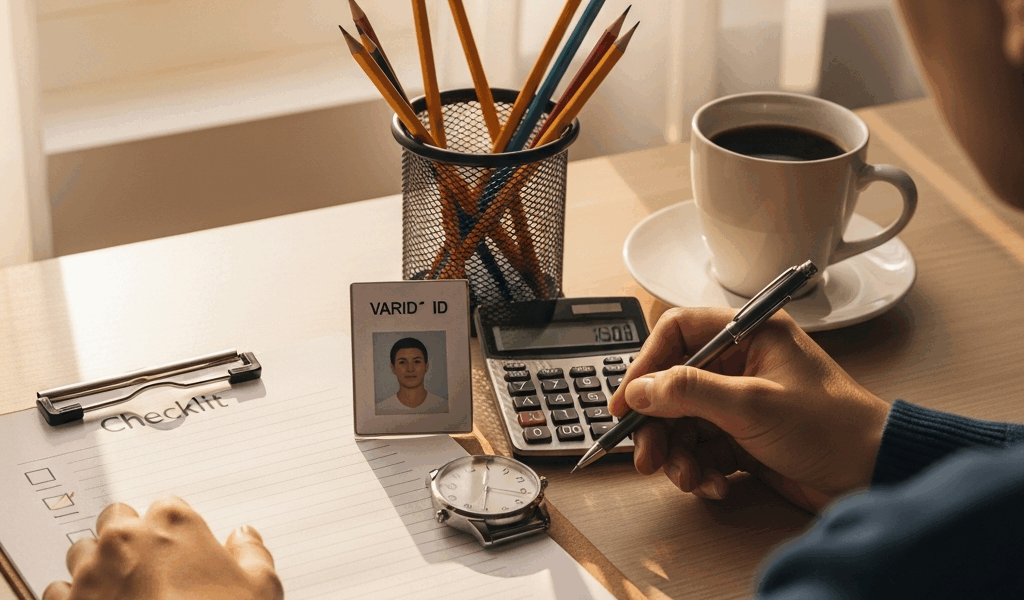
AFOQT Test Day Checklist — What to Bring and Prepare
I walked into my AFOQT test center at 7:45 a.m. feeling genuinely prepared. Three months of study. Practice tests completed. Then I realized I’d forgotten to verify which calculator model was actually permitted — the proctor almost turned me away. That thirty-second panic before she confirmed my TI-30XS MultiView was on the approved list taught me something most prep guides skip entirely: test-day logistics matter as much as content mastery.
The AFOQT test day checklist isn’t about what you know. It’s about removing friction so your brain can focus on the questions instead of logistics anxiety.
What You Can and Cannot Bring to the AFOQT
Let’s start with what the Air Force explicitly requires. You need: a government-issued photo ID (driver’s license, passport, military ID—not expired), two number-two pencils with erasers, and a nonprogrammable calculator. That’s the core.
The calculator rule trips people up constantly. You’re allowed a TI-30XS MultiView, Casio FX-260, or HP 35s. Not your phone’s calculator. Not a graphing calculator. Not the fancy one from high school. I spent twenty minutes researching before test day and found those three models specifically listed in the official regulations. If you don’t own one of these, buy it now — they cost $12–18 on Amazon. Don’t improvise here.
What else you can bring: tissues (useful during the four-hour exam), a watch (analog or digital, no smartwatch), and water in a clear bottle. That’s genuinely it. Your brain might want your lucky pen or study notes “just in case.” Resist that urge.
What fails immediately: your phone (must stay in your locker), any study materials, notes, highlighters, unauthorized calculators, smartwatches, and mechanical pencils. The proctor isn’t being rigid to annoy you. These rules exist because the AFOQT has to maintain standardization across thousands of test-takers. Cheating detection requires consistency.
Gray zone items test-takers often ask about — Can I wear a smartwatch for the timer? No, even as a watch, it’s prohibited. The rule exists because smartwatches can store data. Can I use a mechanical pencil instead? Also no. The scoring machine reads pencil marks specifically, and mechanical pencils mark differently. Can I bring my own tissues? Yes, but honestly the test center provides them.
Probably should have opened with this section, honestly — but people skip it. Don’t be that person who learns three hours before the test that your TI-84 isn’t acceptable.
The Night Before Your AFOQT — How to Actually Rest
You’ve done the work. Cramming eight hours before an exam with a four-hour time limit is pointless. Worse than pointless, actually — it’s neurologically counterproductive. Your brain consolidates memory during sleep, not at 11 p.m. the night before.
Here’s what actually matters. Aim for 7–8 hours of sleep. Not nine (that can make you groggy), not five (your working memory tanks). Seven solid hours. I made the mistake of sleeping 5.5 hours before my test and spent the Verbal Analogies section fighting brain fog. Bad call.
What not to do the night before: avoid heavy caffeine after 2 p.m. (you’ll crash mid-test), don’t eat a massive dinner (digestion pulls blood away from your brain), don’t drink a ton of water before bed (you’ll wake up multiple times), and absolutely don’t try to “cram-study” difficult sections. Your brain needs recovery time more than it needs last-minute review.
What to do instead: lay out everything you’re bringing. ID, pencils (bring both, in case one breaks), eraser, calculator, watch, tissues, water bottle. Put them in a specific bag or envelope. Physical task completion calms the nervous system — you’ve done something tangible.
Plan your route to the test center. Check traffic patterns for the time you’ll be driving. Look at parking. Know which building entrance you need. I spent two minutes mapping this the night before and saved myself fifteen minutes of stress the morning of the test looking for the entrance.
Pre-test anxiety is real. I’m not going to pretend it isn’t. Your heart rate elevates, your stomach gets tight, you second-guess your preparation. That’s neurotypical. What helps: naming the anxiety without judgment (“I feel nervous because this matters”), doing five minutes of deep breathing, and reminding yourself you’ve completed practice tests. You know what this feels like now.
Morning of Test — What Your Timeline Should Look Like
Sample schedule (adjust based on your test time):
- T-minus 120 minutes: Wake up. Drink water. Eat a light breakfast — toast with peanut butter, oatmeal, a banana, or eggs. Not a massive meal. Not on an empty stomach. Something in the 300–400 calorie range that digests in 60 minutes.
- T-minus 90 minutes: Shower (helps with alertness). Use the bathroom. Get dressed in comfortable, layered clothing. Test centers are sometimes cold.
- T-minus 60 minutes: Do a quick mental check — do you have your bag? ID visible? Calculator charged (if applicable)? Start traveling.
- T-minus 15 minutes: Arrive early. Sit in your car or the test center lobby. Breathe. You’re here. You’ve prepared.
Hydration strategy: drink water consistently through the morning, but taper off 30 minutes before your test starts. You don’t want to need the bathroom during Verbal Analogies. During breaks between sections, drink again.
What to eat: something with protein and carbs, nothing sugar-heavy or greasy. A sugar spike followed by a crash during Reading Comprehension ruins focus. I ate a frosted donut before my practice test and tanked the second half. Switched to whole grain toast and eggs before the real exam — made a measurable difference in sustained concentration.
Avoid: excessive caffeine (one cup of coffee is fine; three shots of espresso before a four-hour test creates jitteriness), heavy dairy (can cause digestive discomfort), and anything unfamiliar. Test day isn’t the moment to try a new breakfast food.
During the Test — Logistics You Need to Know
The AFOQT structure: eight sections, roughly 50 minutes of content across four hours including breaks. You get scratch paper (used only for calculations), and you cannot bring scratch paper from section to section. It’s collected.
Break timing: you’re entitled to a break after the first four sections. It’s not optional — take it. Use the bathroom, drink water, eat a small snack if allowed (check your specific test center rules). Proctors won’t restart your timer if you take a legitimate break.
If you flag a question: the proctor knows. Flagged answers are marked but still submitted. You can’t come back to them. Use flags only if you genuinely need to skip and return.
If the technology fails (computer freezes, timing resets oddly): tell the proctor immediately. They have protocols for this. The test center compensates for technical issues. Don’t panic and try to “make up time” on your own. The proctor handles it.
Timing resets between sections. You don’t carry unused time forward. Each section has its own clock. Manage pacing within each section, not across the exam.
Test-Day Mistakes That Cost Points (Not Content Related)
These aren’t about intelligence. They’re about logistics failures.
Arriving late: test centers lock doors at your designated start time. Traffic happens. Leave thirty minutes earlier than you think necessary. Sitting in the waiting area for twenty minutes is better than missing your slot.
Wrong test center: you scheduled at the downtown location. You drove to the airport location. Verify your location one week before. Write it down. Check the confirmation email again the morning of.
Forgotten ID: you cannot test without government-issued photo ID. Not your student ID. Government ID. Driver’s license, passport, military card. Without it, you don’t sit for the exam. No exceptions.
Misreading section instructions due to fatigue: by section six, your brain is tired. Instructions might seem obvious but aren’t. Read them actively. Some sections ask for the best answer; others ask for the correct answer. The wording matters.
Skipping breaks when you shouldn’t: you feel “in the zone” during section three. You skip your break. By section seven, your mental stamina collapses. Take the break. Your brain needs it.
All of these are preventable. That’s the point. You can’t control test difficulty. You can control whether you arrive on time with the right ID carrying an approved calculator.
Execution beats anxiety. Preparation beats last-minute panic. A checklist beats everything.




Stay in the loop
Get the latest afoqt prep updates delivered to your inbox.